Thursday, May 10, 2012

A Cocktail By One Name But Includes Something Else

The custom of ordering a specific spirit in one's cocktail is something we do as second nature. But a court case came up in the New York Supreme Court in 1936 (and upheld in the New York Appellate Court in 1937) that shed light on a practice that set the standard for how drinks are made. The case was brought upon by the Compañia Ron Bacardi. In said suit, the Bacardi family sued a number of New York City bars and restaurants of which the Barbizon-Plaza Hotel and Wivel Restaurant (on West 45th Street) were the defendants on the basis that customers ordering a Bacardi cocktail were not being served what they ordered. In other words, the customer ordered lets say a Bacardi and Coca Cola and were given another brand of rum and Coca Cola. The suit was based on the idea that the Bacardi rum was the popular spirit at the time post-Prohibition.

To be honest, the whole thing sounds a bit odd. The case was littered with weird testimonies as to how a chicken sandwich is made whether with chicken or other poultry meat and how beef stew is actually made with beef or beef trimmings. To add to the weirdness factor, the lawyers for the Bacardi family called to the stand the bartender of the New York Athletic Club and the Deal Golf Club, Andre Guex to testify on how he served the presiding Judge, Justice John L. Welsh (who was a member of both clubs) his Bacardi cocktails. The Bartender stated that he served the judge a Bacardi cocktail with Bacardi and nothing else.

After all was said and done, Justice John L. Walsh, ruled:

"Beyond a reasonable doubt subterfuge and a fraud is subjected on the purchaser when BACARDI rum is left out of a drink listed as a "BACARDI" cocktail."

The decision led to an injunction being filed against the defendants and Bacardi drinkers getting their Bacardi in the Bacardi cocktails that they order. So now when you order a Bacardi and coke, you expect Bacardi. Order a Cuba Libre and you'll probably get well rum if you don't specify a particular brand. Be specific and remember tip your server ;)

FH

For Further Reading
- Click Here to access the article Justice Examines His Club Bartender dated April 28, 1936 from the New York Times website
- Click Here to access the article Cocktails Must Live Up to Name dated April 29, 1936 from the New York Times website

Sunday, January 15, 2012

Dr. Martin Luther King, Jr. and Harlem 1958

I came across a link to an article in the DailyMail.co.uk website entitled FINALLY REVEALED after 44 years: The haunting, rarely seen pictures captured on the night Martin Luther King was assassinated. I highly recommend that you check these out these powerful images. Dr. King was often the target of many attempts on his life. Once of these attempts happened here in New York City on September 20, 1958 during a book signing at a Harlem department store. History would be totally different today if the attempt had been successful.

On September 20, 1958, Dr King was doing a book signing at the Blumstein’s Department Store which was located on 230 West 125th Street (between Seventh and Eighth Avenues). At 3:30pm Dr. King was signing his first published book, a memoir on the Montgomery bus boycott called Stride for Freedom: A Montgomery Story when a woman who was not part of the twenty people that were on line waiting to meet Dr. King approached the table. As the woman slipped in to a narrow opening by the desk, she asked him "Are You Dr. King?" to which he responded with a nod. For his confirmation he received a stabbing to the upper left part of his chest in the form of a silver letter opener. The woman was also found to have a .25-calibre Italian automatic pistol in her dress.

Dr. King was taken to Harlem Hospital and was operated on by famed surgeon Dr. Aubre de Lambert Maynard for two and half-hours. Dr. Maynard described what he saw upon his arrival at Harlem Hospital that evening in the article Reminiscing With Dr. Aubrey Maynard: On Saving Dr. King:

"I went immediately to the operating floor and found Governor Harriman sitting on a stretcher with his Secret Service men. Governor Harriman said, 'Where have you been?' I went into the operating area and they had Dr. King along the side of the operating room, with an intravenous drug in his arm and he was all covered. He was absolutely silent, his eyes were closed. He said nothing at the time. I looked at him. All I could see was the knife, which looked like a large dagger, sticking out of his chest. I went to him, softly spoke into his ear: 'Don't worry, Dr. King, I'm Dr. Maynard. I'll do the very best for you, so don't worry, you'll be all right.' "

"I immediately decided on the position and all the factors necessary for a successful approach to the job. That took a little time. We had to do all that without the knife being touched. When I was satisfied that everything was in order, it was a question of cleaning the skin areas and all over the chest and arm. With that done, we started the surgery and it was carried out, I would say successfully."


Upon the end of the procedure, Dr. Maynard made the following statement to the newspapers referring to the precarious situation Dr. King found him in:

(The seven inch blade) "had impinged on the aorta, a blood vessel near the heart" A puncture of the aorta would have been "instant death"

A sneeze, a cough and even taking out of the blade before reaching the hospital would have resulted fatal to Dr. King. The woman who stabbed Dr. King was deemed to be mentally ill by the Magistrate who oversaw her arraignment and was taken to Bellevue Hospital. Upon hearing about the woman’s mental state, Dr. King issued the following statement through his wife Coretta Scott King:

"She was obviously disturbed and she no doubt is not completely responsible for her actions"

Dr. King made a reference to this incident in his I've Been to the Mountaintop speech given on April 3, 1968. Here are his words as he described what happened:

You know, several years ago, I was in New York City autographing the first book that I had written. And while sitting there autographing books, a demented black woman came up. The only question I heard from her was, "Are you Martin Luther King?" And I was looking down writing, and I said, "Yes." And the next minute I felt something beating on my chest. Before I knew it I had been stabbed by this demented woman. I was rushed to Harlem Hospital. It was a dark Saturday afternoon. And that blade had gone through, and the X-rays revealed that the tip of the blade was on the edge of my aorta, the main artery. And once that's punctured, your drowned in your own blood -- that's the end of you.

It came out in the New York Times the next morning, that if I had merely sneezed, I would have died. Well, about four days later, they allowed me, after the operation, after my chest had been opened, and the blade had been taken out, to move around in the wheel chair in the hospital. They allowed me to read some of the mail that came in, and from all over the states and the world, kind letters came in. I read a few, but one of them I will never forget. I had received one from the President and the Vice-President. I've forgotten what those telegrams said. I'd received a visit and a letter from the Governor of New York, but I've forgotten what that letter said. But there was another letter that came from a little girl, a young girl who was a student at the White Plains High School. And I looked at that letter, and I'll never forget it. It said simply,

Dear Dr. King,

I am a ninth-grade student at the White Plains High School."

And she said,

While it should not matter, I would like to mention that I'm a white girl. I read in the paper of your misfortune, and of your suffering. And I read that if you had sneezed, you would have died. And I'm simply writing you to say that I'm so happy that you didn't sneeze.


And I want to say tonight -- I want to say tonight that I too am happy that I didn't sneeze. Because if I had sneezed, I wouldn't have been around here in 1960, when students all over the South started sitting-in at lunch counters. And I knew that as they were sitting in, they were really standing up for the best in the American dream, and taking the whole nation back to those great wells of democracy which were dug deep by the Founding Fathers in the Declaration of Independence and the Constitution.

If I had sneezed, I wouldn't have been around here in 1961, when we decided to take a ride for freedom and ended segregation in inter-state travel.

If I had sneezed, I wouldn't have been around here in 1962, when Negroes in Albany, Georgia, decided to straighten their backs up. And whenever men and women straighten their backs up, they are going somewhere, because a man can't ride your back unless it is bent.

If I had sneezed -- If I had sneezed I wouldn't have been here in 1963, when the black people of Birmingham, Alabama, aroused the conscience of this nation, and brought into being the Civil Rights Bill.

If I had sneezed, I wouldn't have had a chance later that year, in August, to try to tell America about a dream that I had had.

If I had sneezed, I wouldn't have been down in Selma, Alabama, to see the great Movement there.

If I had sneezed, I wouldn't have been in Memphis to see a community rally around those brothers and sisters who are suffering.

I'm so happy that I didn't sneeze.


Dr. King made a full recovery to continue with his civil rights work until the fateful evening of April 4, 1968. Had the would be assassin in Harlem been able to sink the blade of her letter opener just an inch deeper, civil rights legislation may have taken longer to come to fruition. Who knows how long things would have remained as they were without the work of Dr. King among others that fought for the civil rights for all people.

Thank you Dr. King for all the work you did in your short life. You will always be a beacon that we all can follow regardless of our race, creed or religion. May you always rest in peace

FH

For Further Reading:
- Click Here to access to the article Dr. King, Negro Leader, Stabbed By Woman in a Store in Harlem; DR. KING STABBED IN HARLEM STORE dated September 21, 1958 from the New York Times website.

- Click Here to access to the article Dr. King’s Knifer Sent to Bellevue dated September 22, 1958 from the New York Times Website

- Click Here to access the article Reminiscing With Dr. Aubrey Maynard: On Saving Dr. King dated January 14, 1996 from the New York Times Website

- Click Here to access the blogpost Remember: The Blumstein Awnings from the Harlem + Bespoke blog page to see what the front of Blumstein’s Department Store looked like

- Click Here to access the Dr. Martin Luther King, Jr. Research and Education Institute website

- Click Here to access the PBS Metrofocus article Martin Luther King, Jr. on Broadway – He’s Been There Before for more infomation on the new MLK play starring Samuel L. Jackson and Angela Bassett as well as sources on MLK in NYC

- For a more in depth source on the stabbing of Dr. King in Harlem check out When Harlem Nearly Killed King: The 1958 Stabbing of Dr. Martin Luther King, Jr. by Hugh Pearson on Google Books

- Click Here to access the Seattle Times special look on Martin Luther King and the Civil Rights Movement

Wednesday, November 16, 2011

Art Imitates Life: Bernard Goetz

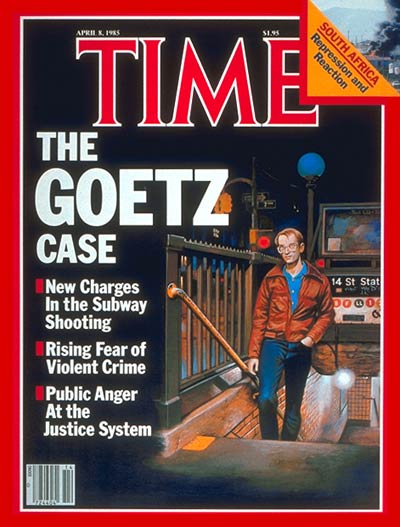
It is amazing how inspiration can come about. I was watching the second episode of Season One of the original Law and Order (Originally broadcast back in 1990) and I notice that the episode is strangely reminiscent of a heated case in New York City during 1984. The episode shows an incident on the New York City Subway where a young white woman pulls a gun out of a crowded Subway train and shoots a number of young black men. Now, sitting there I’m thinking that Law and Order made a few noticeable changes to the Bernard Goetz incident of December 22, 1984. Before I go into what happened on that day almost 27 years ago, allow me to describe to you how the New York City Subway system looked during those days from a person who lived it.

I was in my early teens during that time and the trains and the city were nothing compared to what they are today. The trains were dirty, full of graffiti, lacking air conditioning, stations in disrepair and crime in the city uncontrolled. By the end of 1984 the murder count for the entire city sat at 1,786 with a peak of 2,605 murders in 1990. Consider that in 1995 murders stood at 1,550, 2000 at 952 persons killed and 781 in 2009. People today have it good compared to the early 1980’s, but I digress. That is the world that Bernard Goetz lived in. As per Biography.com’s entry on Bernard Goetz here is how the incident went down:

On December 22, 1984, Goetz entered an empty Manhattan train, carrying an unlicensed .38 caliber revolver. Also on the car were four teenagers: Troy Canty, Barry Allen, Darrell Cabey, and James Ramseur. As witness testimony later stated, Goetz had barely taken his seat when the young men approached Goetz for $5. When Goetz refused, Canty responded, "Give me your money." Suspecting he was being set up for another mugging, Goetz stood up and said, "You all can have it." Goetz started firing his revolver, wounding all four teens. When the train came to a stop, a startled Goetz ran out of the car and eventually fled the city, making his way to Concord, New Hampshire. Eight days after the shooting, Goetz finally turned himself into police.

Where the Mayor of New York City Edward I. Koch stated that “We will not permit people to take the law into their own hands,” the normal folks celebrated the shooter. People saw this incident as a way for the people to take the streets back from the criminal and the thugs who were terrorizing them. On the flip side, race relations in the city, which were already strained, worsened after the Goetz incident. Things came to a head with the two trials against Bernard Goetz.

In the June 1987 trial, Goetz was acquitted of charges of attempted murder and assault at his trial and was sentenced to five years' probation and ordered to undergo psychiatric counseling. The second trial was set for October 1987 for the unlicensed gun charges. The jury found Goetz guilty and sentenced to six months in jail and five years' probation. Goetz’s actions on that subway car in 1984 led to the paralyzing of Darrell Cabey which in turn led to a lawsuit being filed by Cabey in which a judgment against Goetz was $43-million in damages.

Goetz would live a life of brief celebrity after his prison term and has faded into obscurity becoming a footnote for the “good-old days” of the New York City of the 1980’s.

FH

For Further Reading:
- Click Here to access the opinion of the Court of Appeals for the case The People of the State of New York, Appellant, v Bernhard Goetz, Respondent., 68 NY2d 96
- Click Here to access the article WHEN BERNIE GOETZ WAS NEW YORK CITY from the New York Daily News website dated December 19, 2004
- Click Here to access the New York Crime Rates 1960 - 2010 from the Disastercenter.com
- Click Here to access the article Goetz Given 6-Month Term on Gun Charge from the New York Times website dated October 20, 1987
- Click Here to access the article The Goetz Verdict from the New York Times website dated April 24, 1996

Sunday, February 27, 2011

Edward Donald "The Duke" Snider 1926-2011

During the summer of 2007, I visited the exhibit The Glory Days: New York Baseball 1947-1957 located at the Museum of the City of New York. In it I saw first hand the effect that players such as Mickey Mantle, Willie Mays and Duke Snider had on their fans and the city of New York. Listening the song Talkin' Baseball by Terry Cashman also brings back memories of a baseball past that I can only see through newspaper articles and news footage. So when I heard that one of the famed trio of the Golden Age of New York City centerfielders and member of the famed Boys of Summer, Duke Snider passed away at the age of 84, well I felt that had to write something.

Duke Snider was born Edwin Donald Snider September 19, 1926 in the city of Los Angeles California, growing up in the South Central area of the city. Snider was signed by the Brooklyn Dodgers straight out of Compton High School, where Snider was an athletic standout in the sports of baseball, basketball and football. After serving a tour of duty in the Navy from 1944-1946, Snider began his major league career.

Snider debuted with the Dodgers on April 17, 1947 joining a talented team made up with such outstanding players like Jackie Robinson, Pee Wee Reese, Gil Hodges and Carl Furillo. This era is considered to be the Golden Age of New York Baseball. The page for the Museum of the City of New York's exhibit The Glory Days: New York Baseball 1947-1957 describes it as so:

The decade between 1947 and 1957 was the golden age of baseball in New York City. With three major league teams—the Yankees, the Brooklyn Dodgers, and the New York Giants—at least one of whom played in the World Series every year except 1948; two National League teams in an intense rivalry each season; and seven landmark subway series, New York was the undisputed baseball capital of the nation.

From 1947, until they left Brooklyn in 1957, the Dodgers won six National League pennants (1947, 1949, 1952, 1953, 1955, 1956) and winning their only World Series in Brooklyn in 1955. The man known as the "Duke of Flatbush" was a main component of these teams. Snider was a seven time All Star and finished in the top ten of MVP voting six times. Snider continued playing with the Dodgers as they moved to his home town in 1958. He has the distinction of being the last player to get a base-hit at Ebbets Field and the first player to get a hit at Dodger Stadium.

Snider helped the Dodgers win their second World Series in 1959 against the Chicago White Sox. Snider's contract was sold to the New York Mets in 1963 and after a brief return to New York City, Snider's contract was sold to the San Francisco Giants in 1964. Snider would retire in the same year after the Giants released him. Snider would be elected into the Baseball Hall of Fame in Cooperstown in 1980, joining fellow New York Centerfield Greats Willie Mays (1979) and Mickey Mantle (1974).

Former Los Angeles Times staff writer Mike Kupper describes Snider's career as so:

Snider hit 40 or more homers in five consecutive seasons and during the 1950s led all major leaguers in home runs, 326; runs batted in, 1,031; runs scored, 970; and slugging percentage, .569. He finished his career with a lifetime batting average of .295 and 407 home runs, 389 of them as a Dodger, still the team record. He is the only player to have twice hit four homers in the World Series, matching his 1952 feat in '55, the year the Dodgers won the Series and he was named major league player of the year by Sporting News.

Snider remained in baseball as a broadcaster for the San Diego Padres (1969-1971), Montreal Expos (1971, 1973-1986) and the Los Angeles Dodgers (1991), as well as, being a hitting coach for the Montreal Expos (1973-1974).

Having been child in New York City during the 1970's, I would hear the stories about New York's Golden Era of Baseball on baseball telecasts and be envious that I was born too early to have experienced it. Going to the areas of Flatbush and Harlem where the former Ebbets Field and Polo Grounds existed I find it hard to believe that there were major league stadiums erected there once upon a time ago. Another component of the magical era has gone to rest. The Duke has gone to the big ballpark in the sky, joining the Mick in a fabled homerun contest. May the Duke of Flatbush rest in peace.

FH.

For Further Reading:
- Click Here for the Duke Snider obituary written by Mike Kupper from the Los Angeles Times website dated February 27, 2011
- Click Here for the Duke Snider obituary written by Richard Goldstein from the New York Times dated February 27, 2011
- Click Here to access the Duke Snider page from the Baseball Hall of Fame at Cooperstown's webpage
- Click Here to access the transcript of Duke Snider's induction speech given at the Baseball Hall of Fame at Cooperstown on August 3, 1980
- Click Here to access the virtual exhibit of The Glory Days: New York Baseball 1947-1957 provided by the Museum of the City of New York

Monday, January 24, 2011

James Rivington British Publisher! American Spy?

Ever wonder who certain streets are named after? Take my post of December 25, 2007 named Houston Street? Who is it really named after!! as an example. Here I highlight and clarify who Houston Street is named after and no it is not named after Texas hero Sam Houston, read it to see who it is named after. This time around I wanted to highlight who Rivington Street is named after.

Rivington Street is named after James Rivington who some say led a double life while living in New York City during the Revoutionary Era. Rivington was born in London England in 1724 to a family of successful publishers. After his bookstore failed causing him to lose his fortune, Rivington dedcided to start anew in the colonies and in 1760 arrived in Philadelphia. A year later, Rivington would open a new bookstore in New York City where he would be forever be linked to. (PHOTO CREDIT: THE NEW YORK HISTORICAL SOCIETY)

Rivington was a staunch supporter of the British crown and did so in his newspaper which was known as Rivington's Gazetter. At first the newspaper was balanced in its reporting of the news but as events in the colonies took a more rebellious nature the paper took a tone similar to its printer. King's Handbook of New York City 1892 describes one instance where Rivington took the rebellious colonists to task with the revolts following the passage of the Stamp Act of 1765:

In the year 1765 the Stamp Act was passed, and the disruption of America and England began. The New-Yorkers forgot their old-time local controversies, and took sides in the new contest. Rivington's Gazetteer stigmatized the patriots as rebels, traitors, banditti, fermenters of sedition, sons of licentiousness and the like

As you can imagine, press of this kind towards those colonists who were growing more and more anti-British did not go over very well. The rebellious colonists were led by a group known as the Sons of Liberty who grew to become a thorn in the side of the Lieutenant-Governor Cadawallader Colden. Many of their actions took the form of protests, public speeches, erection of liberty poles and to the extreme skirmishes with local redcoats, taking of supply depots and cannons. The Sons of Liberty turned their attention to James Rivington and his Tory newspaper.

As Kara Pierce describes in here scholarly paper A Revolutionary Masquerade: The Chronicles of James Rivington, Rivington's anti-colonist writings caused "satires, effigies and mockeries of Rivington began to appear in writings from popular poets to addresses to the Continental Congress". Rivington seemed to brush off the attacks, often printing them in his paper. Pierce also shows that a war of words had been brewing between Rivington and Captain Isaac Sears, who was considered to be one of New York's leading patriots. Often Rivington printed the letters received by him from Sears and his retort in his paper. These actions infuriated Sears to the point to physical retaliation.

In May of 1775, a group of colonists mobbed the Rivington home and press causing Rivington to flee with fellow Tory Myles Cooper to the British man-of-war Kingfisher. The attacks would come to a head on November 23, 1775 when a group of men on horseback led by Captain Sears attacked on Rivington's printing press. In doing so, the rebels destroyed the press and taking its parts to make bullets. Rivington and his family left New York City for London a disillusioned man only to return to when New York City was under British occupation.

History shows that Rivington continued to print his newspaper through 1783 and after he shut down his operation, Rivington lived with his son something of a poor existence until his death in 1802. Or so we thought. History has a way of making things interesting.

Recent scholarship has brought to light a different angle to James Rivington. It is believed that James Rivington, the staunch Tory publisher was in fact a spy in the employ of the revolutionary spy ring known as the Culper Ring. Based on the research of Robert Townsend's papers by Morton Pennypacker (1872-1956), James Rivington was one of the spies utilized by the Culper Ring and their leader George Washington during the British occupation of New York City. Historian Catherine Snell Crary (1909-1974) published “The Tory and the Spy” in William and Mary Quarterly in 1959 wrote that based on the journals of George Washington's grandson George Washington Parke Custis, James Rivington worked as a spy for the colonies. Historian Philip Ranlet in his book The New York Loyalists states that Rivington worked as a spy for the colonists. As recent as 2006, Kara Pierce has also devoted research to the idea that James Rivington was a spy in the online Journal of History for Binghamton University in the Spring 2006 issue entitled “A Revolutionary Masquerade: The Chronicles of James Rivington”.

Regardless what his reasons for turning against the British, Rivington's actions were essential in the victory of the colonists during the Revolutionary War. Hopefully further scholarship and research can reveal more into the life of James Rivington and maybe he can get some of the credit that he deserves.

FH

For Further Reading:

- Catherine Mary Crary "A Tory and a Spy", William and Mary Quarterly, Third Series, Vol 16 No. 1 (Jan 1959) pp 61-72

- Morton Pennypacker, General Washington's Spies, on Long Island and in New York (New York, Aegean Park Press, 1999)

- Morton Pennypacker, The two spies,: Nathan Hale and Robert Townsend (New York, Houghton Mifflin Co, 1930)

- Kara Pierce “A Revolutionary Masquerade: The Chronicles of James Rivington”, Binghamton University Journal of History Spring 2006

- Philip Ranlet, The New York Loyalists, 2nd Edition (Lanham, University Press of America, 2002)

- New York's Tory Printer New York Times March 1, 1896

Wednesday, December 22, 2010

Brooklyn Navy Yard Fire December 20, 1960

December 17, 2010 marked the 50th anniversary of the mid-air collision of two planes over the skies of New York City. One of the planes landed on Miller Field in Staten Island, the second plane landed on the streets of Park Slope Brooklyn. In total 134 people died. Surprisingly, this wasn’t the only tragedy to affect New York City that holiday season. Situated roughly two miles from the crash site on 7th Avenue and 32nd Street there was a massive fire at the Brooklyn Navy Yard on the future aircraft carrier the USS Constitution. In that accident, 50 workers were killed and 330 were injured. If it wasn’t for Clyde Haberman’s article Recalling a Brooklyn Disaster Otherwise Forgotten from December 21, 2010, I’d have never have known it. Before I go into my views on why this disaster seems to be a footnote in New York City history, let me shed some light on the incident.

According to Charles Grutzner of the New York Times on December 20, 1960 the fire started when a lift truck damaged a 500-gallon fuel tank. The fuel made contact with a welder’s torch causing the temporary wooden scaffold and the other flammable materials used on the construction of the ship to feed the blaze. Within minutes a fire was raging out of control that it took over 12-hours to put it out. Many of the firefighters that were on the scene at the plane crash were also on the scene of the aircraft carrier fire. Watch the following video which chronicles both the Park Slope plane crash and the Brooklyn Navy Yard fire from local news footage of the day for images and more information on both accidents.


In the following days, hearings into trying to resolve the cause of the fire led to accusations by the New York City Deputy Fire Commissioner Albert S. Pacetta that the United States Navy of trying to discredit the Fire Department and their efforts during the fire. Regardless of who was to blame for the accident, the fact remains that 50 civilian dockworkers were killed and 330 were injured without so much as a peep in terms of a public acknowledgement aside from an article in the New York Times.

I made a mention of how certain incidents fall from the mind of people over time in my post on the General Slocum. With that incident, it seems that the lives lost on the fire of the paddleboat are forgotten in comparison to those lives lost on the steamship Titanic a few months later. Why is it that those lives that were lost in the plane crash are honored with a memorial in Greenwood Cemetery and those lost at the Brooklyn Navy Yards are not? Is it possible that we can empathize with people who lose their lives in a plane crash since air travel is something common to every one of us? I really don’t have a concise answer to those two questions. All I’m trying to do is shed a little light on a piece of New York City History that seems to be lost to time.

FH

Wednesday, September 22, 2010

Wall Street Bombing September 16, 1920

Imagine this scene: You are standing on the Northeast corner of Broadway and Wall Street looking eastward. The date is September 16, 1920 and the day is cool and comfortable. You note that the street is bustling with activity in the minutes before noon chime goes off in the above looming Trinity Church. Men and women walk along taking care of their daily business. Street vendors sell their wares to the passing public. It seems like a scene out of the Wall Street from the year 2010, well aside from the armed Federal guards and the street barriers.

You walk down Wall Street towards the corner of Wall and Broad Streets and come face to face with three future landmarks of New York City’s financial district. To your left is Federal Hall, made famous by George Washington and his inauguration as this nation’s first President. Behind you to your right are the columns of the New York Stock Exchange building. In front of you on your right is the JP Morgan building at 23 Wall Street (The view in the above picture is from Federal Hall with the 23 Wall Street in the front and the New York Stock Exchange on the right). You look down at your watch and notice that that the minute hand has joined the hour hand on the number 12. That innocent looking horse drawn wagon that sat across from the Morgan building goes from being innocent to lethal leading to the deaths of 38 people and injuring hundreds more. This is Wall Street, September 16, 1920. (PHOTO CREDIT Mark Lennihan/Associated Press).

What exactly happened on that fateful day? To best describe the event I quote author Kevin Baker in his New York Times review of Beverly Gage’s book The Day Wall Street Exploded: A Story of America in its First Age of Terror:

The bomb was an immeasurably cruel device, most likely dynamite tied to iron sash weights that acted as shrapnel. It blew people apart where they walked out on a cool, late-summer day, tore arms and legs, hands and feet and scalps off living human beings. Others were beheaded or eviscerated, or found themselves suddenly engulfed in flames. Still more injuries were caused by a cascade of broken glass and the terrified stampede that followed.

Given the political climate at the time, it was believed that that those responsible for the attack were radical Anarchists. Later it was believed to have been planned by agents of Soviet ruler Vladimir Lenin. After exhausting investigations by the New York Police Department and the Bureau of Investigations (predecessor to the Federal Bureau of Investigations) of witness statements and numerous arrests with no convictions the case remains officially unsolved.

According to scholars, it is believed that attack was perpetuated by a known radical by the name of Mario Buda (1884–1963) aka Mike Boda. Paul Avrich in his book Sacco and Vanzetti: The Anarchist Background claims that the reason for Buda's attack was in protest of the arrests of his friends Nicola Sacco and Bartolomeo Vanzetti. Sacco and Vanzetti were arrested, tried and executed for their believed roles in the South Braintree (Massachusetts) holdup that led to the killing of a paymaster and a guard on April 15, 1920.

Mike Davis, author of Buda's Wagon: A Brief History of the Car Bomb, states that Buda was a supporter of Luigi Galleani (1861-1931). Galleani was an anarchist theorist and editor of the Cronaca Sovversiva an Italian anarchist periodical. The Galleanist

Why Buda picked Wall Street as a location for his message is unknown. It is also not known whether he acted alone or with other anarchists. What is known is that a message was left in a mailbox on the corner of Cedar Street and Broadway. The message in red letters read as so:

Remember
We Will Not Tolerate
Any Longer
Free The Political Prisoners
Or It Will Be
Sure Death For All of You
American Anarchist Fighters


Why wasn't Buda ever arrested? After the bombing, Buda made his way back to Providence, Rhode Island where after getting a passport from the Italian Vice-Consul, Buda boarded a ship heading to Italy where he remained until his death in 1963.

The Wall Street Bombing of 1920 was the largest terrorist act on American soil until the attack on the Alfred P. Murrah Federal Building in downtown Oklahoma City on April 19, 1995. The attack was the largest terrorist act in New York City history until it was eclipsed by the attacks on the World Trade Center on September 11, 2001.

FH

For Further Reading:
Paul Avrich, Sacco and Vanzetti: The Anarchist Background (Princeton, Princeton University Press, 1991)

Mike Davis, Buda's Wagon: A Brief History of the Car Bomb (London, Verso Press, 2007)

Beverly Gage The Day Wall Street Exploded: A Story of America In Its First Age of Terror (Oxford, Oxford University Press, 2009)

- Click Here for the Trial of Sacco and Vanzetti 1921 page with maps, images and excerpt of the trial

- Click Here for the Palmer Raids post on the FBI Wall of Shame blogpage for some background on the Galleanists and other anarchist groups.

Wednesday, August 11, 2010

New York City As An Example of Religious Freedom

Mayor Bloomberg went against popular opinion last week and decided to back the building of the mosque near Ground Zero. By holding the press conference at Governors Island, with the Statue of Liberty and Lower Manhattan in the background, Mayor Bloomberg stated that on the island that he stood on "the seeds of religious tolerance were first planted". He would later describe the efforts of both the Jews and Quakers to establish their religious rights within the New Amsterdam colony (as I have written about in both the Who is Asser Levy and the Flushing Remonstrance posts).

Unlike the other colony in Massachusetts with their shining city on the hill who banned those who did not have the same religious beliefs as they did (while banning those of the same faith who aided them get to the 'New World" while exiled in Europe), the New Amsterdam colony was unique. I won't say that it was for altruistic reasons that religious freedom came about in New Amsterdam. No it was simply about one thing: Money.

The Dutch West India company set up the New Amsterdam colony for one reason and one reason only: To Make Money. With so many people of different races, creeds and religions coming into such a small and confined space it was inevitable that there would be conflicts. The heads of the Dutch West India company realized that to make money, concessions must be made and one of those concessions was the freedom of religion. The company wasn't there to regulate religious beliefs but to ensure that the colony was profitable. Happy colonists meant profitable colonists. This is why the first Jewish congregation was set up in 1657 and the Quakers were able to practice their religion without fear of persecution in 1662.

It is with these "seeds" as Mayor Bloomberg eloquently spoke about on Governors Island that New York City has always been the place for religious freedom. It hasn't always been easy. But that is one of the reasons why Historically New York City will always be different from not only every city in the United States but in the entire world. Whether that remains to be seen with the protests against Mosques not at Ground Zero but also in Staten Island. Time will tell.

FH

For Further Reading:
- Click Here for the full transcript of Mayor Bloomberg's speech from Celeste Katz's Blog page on the New York Daily News website

FH

Thursday, August 5, 2010

Return to the Jewish Arrival to New Amsterdam 1654

In my post of January 14, 2010 called Who Was Asser Levy I wrote about the story of how the Shearith Israel Congregation came to become the first Jewish congregation in New Amsterdam.

The story shows that the congregation was formed due to the emigration of 23 Jewish refugees from the former Dutch colony of Nieuw Holland in 1654 to New Amsterdam. Their arrival put them at odds with the Dutch Director-General of New Amsterdam Peter Stuyvesant. Though Stuyvesant tried to have these refugees expelled from his colony, his attempts were rebuked by the Dutch West India company and by 1657 the Jewish refugees won full rights within the colony. Ok, that's the story in a nutshell. As with any historical event, there is always more than meets the eye and my research on the matter has dug up a more elaborate scenario. So here goes.

It is accurate that the Dutch colony of Nieuw Holland was taken over by the Portuguese under General Francisco Barreto de Menezes. Menezes gave the order that those who did not want to live under Portuguese rule in the colony had six months to leave. In order to facilitate the evacuation, Menezes provides the colony's refugees with sixteen ships that were to sail from Nieuw Holland to Holland. In making the journey to Europe, many of the ships faced peril in the form of dangerous conditions and pirates. Many of these ships did not make it to Europe. The ship that carried the Jewish refugees was one such ship.

Here is where I find different branches to the story. In my original post, I said that the Jewish refugees arrived in New Amsterdam during the month of September of 1654 aboard the ship the Sainte Catherine. Ana Domingos and Paulo Mendes Pinto in their article Tracing the History of the First Jews in the US state the following:

One of the boats was attacked by pirates in Cuba, but the lives of twenty-three Portuguese Jews were saved by a French ship, the Sainthe Catherine...On September 7, 1654, the Sainthe Catherine arrived in Dutch waters at the port of the city of Nieuw Amsterdam. Its captain, Jacques de la Motthe, said farewell to the ones he saved, leaving behind the first Jewish settlers in North America.

Well that was very nice of Captain de la Motthe. But like I said before, there is always more than meets the eye. Abraham J. Peck in his article Creating Jewish New York sheds more light on Captain de la Motthe's motives:

The generally accepted history is that in late August or early September of 1654, a French ship--called variously the St. Catherine or St. Charles--captained by Jacques de la Motthe, arrived in the harbor of New Amsterdam with a number of Dutch refugees, including 23 Jewish men, women, and children, presumably from Recife. The surviving docu mentary references have given rise to a number of theories regarding the route and circumstances that brought these pioneers to Peter Stuyvesant's small village.

At least two Jews met the boat: Solomon Pieters or Petersen, who appears briefly in the Dutch records as advocate for the Jews in their first dealings with Stuyvesant; and Jacob Barsimson, an Ashkenazi trader who had just arrived in the colony. Captain de la Motthe sued his Jewish passengers for the promised fare, and when they were unable to meet his demands, two heads of family were imprisoned as hostages until funds to pay the debt could be obtained from relatives in Amsterdam.


To further shed light to the arrival of the Jewish refugees to New Amsterdam, I found the following from the passenger logs from the St. Charles on Olivetreegeneology.com:

St. Charles 1654

The Dutch administrations in Brazil, which succeeded that of Gov. Maurice, were inefficient and corrupt. The Portuguese revolted and the Dutch finally capitulated January 25, 1654. They were given three months in which either to depart or to embrace the Roman Catholic religion and become Portuguese citizens. In April 1654, there was a fleet of sixteen Dutch ships in the Harbor of Recif to evacuate the Dutch Protestants together with a small number of Dutch and Portuguese Jews.

On 7 Sept. 1654 Capt. Jacques de la Motthe/Motte, skipper of the St. Charles, appeared in court with a petition. He required payment for freight and board 'of the Jews whom he brought here from Cape St. Anthony". de la Motte states that "the Netherlanders who came over with them" are not included in his suit and that they have paid him. Solomon Pietersen "a Jew" appears and says that "900 guilders of the 2500 are paid and that there are 23 souls, big and little [meaning adults and children] who must pay equally"

[Source: The Records of New Amsterdam from 1653 to 1674 Anno Domini, edited by Berthold Fernow in 7 volumes. reprint Genealogical Publishing Co. Inc. Baltimore. 1976 Vol. I Minutes of the Court of Burgomasters and Schepens 1653-1655 p 240]

The names I have found so far (using primary records only) are:

Abram Israel
David Israel
Asser Levy
Moses Ambrosius
Judicq de Mereda

It is not clear if Solomon Pietersen was on board the ship so I have not added his name to the list.

Another passenger (non-Jewish) was Dominie Joannes Polhemius

From what can be pieced together about them, it seem probable that the twenty-three consisted of six family heads---four men (with their wives) and two other women who in all likelihood were widows, since they were counted separately---and thirteen young people. The heads of the families were Asser Levy, Abraham Israel De Piza (or Dias), David Israel Faro, Mose Lumbosco, and ---the two women---Judith (or Judica) Mercado) (or De Mercado, or de Mereda) and Ricke (or Rachel) Nunes. [Source: The Grandees: America's Sephardic Elite by Stephen Birmingham]


Leo Hershkowitz in his article By Chance or Choice: Jews in New Amsterdam 1654 adds the following to the argument:

In late summer 1654, two ships anchored in New Amsterdam roadstead. One, the Peereboom (Peartree), arrived from Amsterdam on or about August 22. The other, a Dutch vessel named the St. [Sint] Catrina, is often referred to as the French warship St. Catherine or St. Charles. Yet, only the name St. Catrina appears in original records, having entered a few days before September 7 from the West Indies. The Peereboom, Jan Pietersz Ketel, skipper, left Amsterdam July 8 for London, soon after peace negotiations in April concluded the first Anglo-Dutch War (1652–1654). Following a short stay, the Peereboom sailed for New Amsterdam, where passengers and cargo were ferried ashore, as there were no suitable docks or wharves. Among those who disembarked were Jacob Barsimon, probably together with Asser Levy and Solomon Pietersen. These were the first known Jews to set foot in the Dutch settlement, and with them begins the history of that community in New York.

So what does all this mean. I believe that the arrival of the Jewish refugees to New Amsterdam was much more complicated than I posted. The fact that the refugees and their possessions were basically held for ransom by the Captain of the St Catherine. The story of the battle between Captain de la Motthe and the Jewish refugees was documented in detail in The Green Bag: An Entertaining Magazine for Lawyers 1901. Lee M. Friedman documents in his article The Petition of Jacques de la Motthe (Volume XIII No 8 August 1901 Pg 396-398) the attempts of Captain de la Motthe to receive payment of the Jewish refugees. He attempted to do so by means of filing suit against the refugees and later through the attempted sale of their possessions by public auction. In the end, the refugees appealed to the better nature of the crew of the Saint Catherine. The crew heard the pleas of the Jewish representative Solomon Pietersen and decided to wait for their payment until their return to New Amsterdam on a later voyage.

It was at this point that Stuyvesant attempted to have the refugees removed from the colony by his appealing to the West India Company. His appeal was rejected due to the Jewish influence within the West India Company and the belief that the colony was there to make money. As the saying goes: The rest is history.

FH.

For Further Reading:
- Click Here to read the Ana Domingos and Paulo Mendes Pinto article Tracing the History of the First Jews in the US
- Click Here to access Abraham J. Peck's article Creating Jewish New York
- Click Here to read the ship's log for the St. Charles from Olivetreegeneology.com
- Click Here to read the Leo Hershkowitz article By Chance or Choice: Jews in New Amsterdam 1654 in PDF format
- Click Here to access the Google Books Digitized Version of the The Green Bag: An Entertaining Magazine for Lawyers 1901. Lee M. Friedman article on the Petition of Jacques de la Motthe, pg 396-398

Thursday, June 17, 2010

The Sinking of the General Slocum June 15, 1904

On June 15, 1904, a steamship leaves the dock in the neighborhood that was known as Little Germany up the East River for the serene waters of Long Island Sound. Aboard the ship that was named after a Civil War were over 1,000 people who were looking forward to a Sunday school picnic along the shores of Long Island. As little as an hour later, the ship would be ablaze with a panicking public aboard a ship whose safety precautions all failed. This tragedy which happened 106 years ago was the biggest tragedy in the history of New York City until the events of September 11, 2001 and is largely forgotten. Here is my attempt to shine a little bit of light on an event that should never be forgotten.

In 1904, the neighborhood of Little Germany was made up from 14th Street to the North, Houston Street to the South, 2nd Avenue to the West and the East River to the East which currently make up the neighborhoods of the East Village, Alphabet City and the Lower East Side. The center to the neighborhood was the St. Marks Evangelical Lutheran Church on 6th Street, which was led by Reverend George Haas. It was his congregation that made up the majority of the victims of the General Slocum.

Named after Civil War hero General Henry Warner Slocum (September 24, 1827 – April 14, 1894), the General Slocum was a 264-foot long wooden steamship paddleboat with three large open decks that was piloted by Captain William Van Schaick. The boat was slowly filled with many parishioners of the St. Marks Church as well as Irish, Italian and Jewish immigrants that lived and worked within the neighborhood of Little Germany. At 9:40 am, the ship pushed off into the busy and crowded East River from the 3rd Street pier as bands played German music on the docks. Little more that twenty minutes later, a fire that was generated deep within the bowels of the ship and was starting to consume the ship leaving its passengers in a frightened panic.

The ship continued on course up the East River passing the treacherous segment known as the Hell Gate (Author's Note: As a someone who was born and raised in Astoria, the stories of the Hell Gate are well known. A child in my Junior High School drowned in those waters and I saw how the water churned in many different directions while hanging out at the Strip that ran along side Astoria Park). While the boat burned and sailed on, the passengers tried to release the lifeboats that were on the top deck. To their chagrin, the lifeboats had been affixed to the decks and the passengers in vain tried to dislodge them. Many other passengers tried to save themselves with the safety vests that similar to the lifeboats were not in working order. Many of the vests simply ripped apart. Those that were preserved complete the cork that made the up the buoyancy for the vests had decomposed into powder, which led to those passengers, who wore them in the water to sink instantly. The water hoses that were crucial to the fighting of the fire were faulty, full of holes and burst when the water passed through them. The ship had been inspected and passed only five weeks before the tragedy.

Instead of trying to dock along the Astoria coastline, the captain decided to head to North Brother Island off the coast of the Bronx. To make matters worse, as the ship was navigating past the Hell Gate, the top deck collapsed from the effects of the support beams being burned away and from the ship hitting rocks underneath the water. The bone jarring collision sent many passengers flying off the portside into the churning waters of Hell Gate to a swift death. Women and the children were burdened by heavy and restricting clothing, which only helped to cause then to drown even faster.

On North Brother Island was a hospital that was being utilized for those patients that were being quarantined because of contagious illnesses (one of the hospital’s most famous patients was "Typhoid" Mary Mallon). As the General Slocum was approaching the island, the hospital’s Doctors, Nurses, Administrators and even patients ran out to help. As the living were taken from the water and the ship, the ship continued to drift in the water and finally landed more than a mile away on the beach at Hunt's Point.

In total, over 1,000 people, mainly women and children perished. An inquest would later find all the employees innocent of all charges except for the Captain who was found guilty and sentenced to 10 years in prison in Sing Sing (Van Schaick served three and a half years and was pardoned by President William Howard Taft). The families received a $500 dollar insurance payment for each family member lost in the tragedy. The neighborhood of Little Germany was decimated and faded away.

Though the neighborhood has changed, two markers remain to remind those of the former Little Germany. The former St. Marks Evangelical Lutheran Church is still standing on 6th Street but it is now known as The Sixth Street Community Synagogue having been taken over by a number of Jewish parishioners in November 1940. The second marker is located within Tompkins Square Park. As per the New York City Parks Department Website:

The Slocum Memorial Fountain by sculptor Bruno Louis Zimm was donated by the Sympathy Society of German Ladies and installed in Tompkins Square Park, a central feature of the neighborhood. The nine-foot upright stele is made of pink Tennessee marble with a low relief of two children looking seaward as well as a lionhead spout.

Ironically, the Titanic disaster occurred 8 years later becoming part of American history and spawning tales of heroism and legendary accomplishments while the General Slocum is seen as being no more than a historical footnote. Regardless of how it is seen by many, it is an event that should never been forgotten. Ever.

FH.

For Further Reading:
- O'Donnell, Edward T. O’Donnell Ship Ablaze: The Tragedy of the Steamboat General Slocum, 2004.
- Click Here for the text of the New York Times June 16, 1904 about the General Slocum Tragedy
- Click Here for the text of the Brooklyn Daily Eagle June 15, 1904 about the General Slocum Tragedy
- Click Here for the GeneralSlocum.com webpage
- Click Here for an amazing website created by Jim Kalafus, a great-grandson of one of the victims of the General Slocum Tragedy
- Click Here for a Blog Page about North Brother Island with recent pictures of the buildings still standing on the island
- Click Here for the NYC Parks Department website listing for the Slocum Memorial Fountain
- Click Here for the NYC Parks Department website as it refers to Astoria Park and the General Slocum Disaster
- Click Here for the NYC Parks Deparment website for North and South Brother Islands

Tuesday, May 25, 2010

The Shearith Israel Congregation and its aid to the Irish People

I came across the news of this story this past weekend in both the New York Times and the Irish Independent and realized that it tied into a prior post of mine. The Irish Potato Famine lasted from 1845-1852 and caused the deaths of approximately 1 million people and caused mass emigration from Ireland mainly to the United States. Bearing similarities to the fund raising efforts to help those in need in today's places of crisis, the victims of the Irish Potato Famine were aided by religious and humanitarian groups worldwide. One such religious group here in New York City reached out and aided the Irish. That group was the congregation of Shearith Israel. How does the Shearith Israel congregation fit into one of my prior posts? Read on.

The foundations for the Shearith Israel Congregation was laid by the 23 Jewish refugees who came to New Amsterdam from New Holland in 1654 (Click here to access the prior post detailing struggle of these original 23 refugees). By 1847, the congregation was located on Crosby Street between Broome and Spring Streets in today's SOHO section of New York City (Its current location is at 8 West 70th Street). As history had recorded it, the fates of the congregation of Shearith Israel and the Irish were forever linked on March 8, 1847.

Leading the charge to help those in need across the Atlantic was the minister of the congregation Jacques Judah Lyons (1813-1877). Born in Surinam, Dutch Guiana on August 25, 1813, Lyons' family emigrated to Philadelphia and made his way to New York City where he was elected the minister of the congregation of Shearith Israel in 1839 serving as said minister for 38 years until his death in 1877. Lyons' saw the need to aid the victims of the terrible famine in Ireland and he called upon his congregation to provide necessary aid. Here is part of his speech to the congregation on March 8, 1847:

Yet sadness and gloom pervade the land. A nation is in distress, a nation is starving. Numbers of our fellow-creatures have perished, dreadfully, miserably perished from hunger and starvation. Millions are threatened with the same horrid fate, the same dire calamity. The aged and the young, the strong and the feeble alike are prostrated. The heart of civilization is touched by the distress and wo of the sufferers. Relief, and if not relief at least alleviation, is the first sentiment to which utterance is given, and in obedience to that sentiment are we, my brethren, assembled this evening. When information was received in our country that great distress existed in unhappy Ireland, that her inhabitants, her peasantry and her labourers were suffering from the failure of the potato crop, that supplies must be drawn from this and other countries, the benefits we were to derive from such a state of affairs was the paramount consideration. That cases of individual suffering would ensue was admitted.—That the energies and capacities of the people would surmount their difficulties was confidently predicted, and it was not till the reality was made evident to us, not until we were absolutely horrified and heart-sickened by the accounts of the distress that measures were taken to prevent if possible the further ravages of the visitation. Our fellow-citizens have come forward with promptitude and generosity; contributions have poured in from all classes, from all sects. Aid and assistance to unhappy Ireland—raiment, food and life itself to her destitute people are now invoked at your hands. Each of you, I know, acknowledges the necessity of action, each feels that a state of affairs there exists, which it is the duty of society to change and improve. But while there is no diversity of opinion on these points, there is a great diversity of opinion as to what we should do in the premises. We are told that we have a large number of our own poor and destitute to take care of, that the charity which we dispense should be bestowed in this quarter, that the peculiar position of ourselves and our co-religionists demands it at our hands, that justice is a higher virtue than generosity, that self-preservation is a law and principle of our nature. Examine these objections for yourselves. Reflect upon them seriously and conscientiously; then ask yourselves whether they be forcible and true, or whether they are not in fact excuses which the lips utter, while they are rejected by the heart.—Ask yourselves if the contribution which this day you are requested to make will diminish in the smallest degree the other calls which you admit are imperative and binding; and if the responses be those which I anticipate, our meeting for this purpose will not have been in vain. It is true that there is but one connecting link between us and the sufferers; that while most others know only apolitical and geographical separation from them, we alone realize that formidable and eternal one which the hand of man made not. But thanks to the Lord that connecting link is strong enough, and long enough to withstand all attempts to make the separa tion complete and irreparable. Prejudice, bigotry, fanaticism with their attendant spirits, ignorance, intolerance and persecution cannot break it. Selfishness, avarice, cruelty in vain assist in the unholy work. Forged as it was, by religion, virtue and charity it is indestructible, it is all-powerful. That link, my brethren, is HUMANITY! Its appeal to the heart surmounts every obstacle. Clime, colour, sect, are barriers which impede not its progress thither.—Reason at its approach deserts its strong places, its impregnable fortresses. Pride from its lofty seat and imperious throne leaps down to welcome its presence. It is lighted on its way by the divine spirit within us, and the halo and glory which accompanied it illumines its biding-place long, long after its departure. It is this which has brought you here to-night, it is this and this only which will produce any result from this assemblage. Nothing that I can say, nothing that the more eloquent gentlemen who are to follow me can say (and I speak this with a full appreciation of their abilities and eloquence) can add one word which will make its action more prompt, its result more satisfactory. Its promptings enforce their own obedience, its commands require neither interpreter or assistant.

I have taken it for granted that you are all well acquainted with the present state of Ireland; that you are fully aware that the pursuit of its population is agriculture; that its land is chiefly owned by large proprietors, few of whom live on their estates; that it possesses no government of its own, and that its wants, its prosperity, its existence, depend upon the caprice of a minister, or the exigencies of a party; that the failure for two successive years of the staple article of food, and the withdrawal from its shores (even in such times) of its productions for the use of its absent landlords, have all tended to that end. I have also omitted all details of the sufferings of the people, though of thrilling interest, and affecting and persuasive for my purpose. Neither shall I dwell upon the position in which we are placed, as the first Israelite Congregation assembled for this purpose; that the eyes of the community are turned upon us, that their attention is directed to us, ought not, cannot, and will not affect us. The ground on which we stand is holy ground. No evil thoughts, no base passions, no worldly considerations here actuate us. The better principles of our nature here exercise their beneficent and ennobling control. Our hearts turned to God and his glory, his goodness, his mercy, direct us to that hath which his laws and his commandments teach us to he the true one. The guide-posts to the path are numerous and distinct; and among the first and foremost placed before our eyes do we behold thee, oh, Charity! We recognise thy beautiful face, beaming with goodness and cheerfulness, and reflecting the joy and the happiness which thy practice brings with it. We neglect not thy precepts, we fail not at thy bidding. I have endeavoured briefly, and I know imperfectly, to express the ideas which have presented themselves to me on this occasion. I have sought to impress them on you, not by texts drawn from our sacred writings; not by arguments based on our creed, our forms, our traditions, or our laws; not by appeals to your sympathies, your passions, or your pride. I have attempted only to to express the ONE simple truth, that the sufferings of our fellow-men, wheresoever and howsoever situated, demand from us alleviation, assistance and relief. Grant it in this case, for it is a pressing one. Grant it, mothers, for mothers once happy and blessed as ye are ask it of you for their own sakes and for the sakes of their suffering babes; they ask it of you by that bond of sympathy which nature has created between ye; they ask it of you with streaming eyes and outstretched hands, to save them from disease and starvation. Grant it, wives: to save a famishing husband, a wife asks it of you, and what stronger claim can she present to you? Grant it, sisters: in a brother’s name, in the name of the poor of Ireland, to contribute your portion towards alleviating the sufferings of the destitute, and to illumine with joy the dreary path of those who are dying of starvation, with no roof, save yon canopy of heaven, to shelter them from the keen blasts of the tempest’s fury, or the pitiless ravings of the midnight storm. With hopes blasted and prospects blighted, they must now battle with the His of life, and contend with that misery which awaits them in their onward struggle.

“Should we not cherish, then, sweet charity,
Peace, and good-will, the bright humanities,
To shed a cheering radiance o’er the gloom,
To arch the glittering rainbow on the cloud,
Lift from the o’er-tasked heart its crushing grief,
Still the wild blasts and smooth the raging waves,
Bid the eye sparkle joyous through its tears,
Drive from the shattered temple of the soul
The fiend misanthropy, restore the shrine
Of faith; and, wreathing it with fresh new flowers,
Let the bright angel Love administer
Again, in gifts of goodness to mankind?”

And for whom do I plead? For Ireland, unhappy Ireland! the birthplace of that Emmet, who stood unrivalled for the splendour of his talents and the brilliancy of his legal attainments ; for the land of that departed martyr, who, in the last moments of existence—ay, when his grave was opening to receive him—promulgated the noblest sentiments of the human heart, in accents soul-stirring and eloquent, in language beautiful and sublime.

As American citizens, are we not under great and lasting obligations, to the people of Ireland? On the bloody field of battle, during our struggles for liberty, were there no Irishmen engaged in the contest? no generous and daring son of the Emerald Isle, that nobly and bravely stepped forward to the rescue? He who fell at Quebec, while leading on your troops, and urging them to victory, drew the first breath of life in Ireland’s persecuted clime; and he, whose tomb has been bedewed with the tears of his mourning countrymen, that illustrious soldier and conquering general, who for two successive terms filled the highest office within your gift, was born of Irish parents. And now, let me ask you if Ireland has no claims upon our sympathy, no demands upon our friendship, for services rendered in the darkest hours of adversity, in our conflict for liberty, in our struggles for equal rights? But, admitting that we act up to the principle that individuals as well as nations are ungrateful, has she then no claims upon us on the broad ground of charity, and of its heavenly attribute, brotherly love?


By the end of the sermon, the congregation combined to collect $200 dollars ($80,000 in today's dollars) to aid in the relief of the victims of the famine. So how is this relevant to today aside from the parallels to today's fundraising for worldwide victims of natural disasters? The President of Ireland, Mary McAleese (who was in the city for a four day tour commemorating the Irish Potato Famine) visited the congregation Shearith Israel this past Sunday May 23, 2010 to give thanks from the people of Ireland to the congregation who so generously gave aid during a dark time in Ireland's history.

For Further Reading:
- Click Here for the New York Times article by Jim Dwyer about the President of Ireland's visit to Congregation Shearith Israel
- Click Here for the Irish Independent article by Caitriona Palmer on President McAleese's visit to Congregation Shearith Israel
- Click here to visit the official webpage for the Congregation Shearith Israel
- Click here for the entire sermon given by Jacques Judah Lyons on March 8, 1847 from the Occident and American Jewish Advocate April 1847
- Click here for the guide to the papers of Jacques Judah Lyons located at American Jewish Historical Society which has a biographical note for Reverend Lyons
- Click Here for a history of the Irish Potato Famine from The History Place

Friday, February 26, 2010

Valentine's Day and the Home Grown Gangster

Now that the corporate "holiday" known as Valentine's Day has come and
gone, I wanted to put a spotlight on someone whose name will forever be linked to the day. Now I'm not sure if this gentleman was a regular Rudolph Valentino in his day but it wasn't his sexual prowess that is linked to the date February 14. It was his aggression, not love, towards his fellow gangster Bugs Moran and his gang, The North Side Gang that is famous, or rather infamous. On the morning of the 14th of February of 1929, seven men were gunned down in cold blood in a warehouse on North Clark Street in Chicago, Illinois. Now you may ask why am I talking about a gangland hit that occured in The Windy City on a New York City history blog site. Well folks, the believed architect of the whole shebang and who would end up being known as Public Enemy Number One was born, raised and learned his craft here on the streets of good old NYC. That man was Al Capone, otherwise known as Scarface.

Alphonsus "Al" Capone was born on January 17, 1899 in what is now the Red Hook section of Brooklyn to Gabriele Capone and Teresina Raiola who hailed from Naples, Italy. His family would eventually settle down in the Park Slope area of Brooklyn on the edge of Park Slope. Though Capone was a bright child, the lure of the street proved to be too hard to resist. It was on these rough and tumble streets that Capone started his hands on education in the life of crime. Capone would leave school while in the sixth grade at the age of 14, never to attend school again. Capone had joined a number of kid gangs such as the Brooklyn Rippers and the Junior Forty Thieves. These gangs proved to be a minor league of sorts for the major league of New York City gangs: The Five Points Gang (along with fellow gangster Charles
"Lucky" Luciano). The leader of the gang was none other than Johnny Torrio. It was while associated with Johnny Torrio that Capone's path would be set in stone.

Johnny Torrio took Capone under his wing while with the Five Pointers and in 1917 got him a job at Frankie Yale's Harvard Inn. The club was located in Coney Island Brooklyn and would be famous for the place where Capone would earn his nom-de-guerre. After making some inappropriate comments to a female patron, Lena Gallucio. Her brother, Frank Gallucio, would later return to the club looking for and confronted Capone. After all was said and done, Capone's face had been slashed leaving a nasty scar on the left side of his face earning him the nickname of Scarface. In a later twist concerning Capone and Yale, it is believed that Capone ordered the hit that would lead to Frankie Yale's assassination July 1, 1928. The suspected hit came about due to a disagreement about the protection of Capone's bootlegging merchandise. It is believed that a number of the hitmen that executed the hit on Yale also participated the St. Valentine's Day Massacre of 1929.

It was around this same time that Capone met a young lady named Mary "Mae" Couglin. They would end up having a son together whom they named Albert Francis "Sonny" Capone on December 4, 1918. They would be wed on December 30th of the same year at the St. Mary Star of the Sea Church which is located in Carroll Gardens, Brooklyn.

Capone's criminal activities would eventually catch up to him in the form of a prison term at Sing Sing Prison, located in Ossining New York in 1919. Once released from prison in 1920, Capone was asked to join Torrio who was in Chicago working gangster James "Big Jim" Colissimo. Capone worked in various bars and clubs owned and operated by Torrio until the day that Torrio took over Colissimo's empire after his assassination. With Torrio as the boss, Capone would become his right hand man, eventually becoming the boss in 1925. The rest as we know it is history.

For further reading check out these websites:
The Gridskipper has an amazing page on Al Capone's Brooklyn with pictures. Click Here.
The Federal Bureau of Investigation's Webpage on Al Capone. Click Here.
A Webpage called Blood, Roses and Valentines about the St. Valentine's Day Massacre. Click Here.
The Chicago Historical Society page on Al Capone. Click Here.

Sunday, February 7, 2010

Why is there a Castle Hill in the Bronx if there is no Castle or Hill

So, for years now my wife and I have been joking about why is the Castle Hill area named as such since there are no castles or hills in the area. So as I've been known to do, I searched around and found out. Here goes folks.

While Adriaen Block of Dutch New York fame (I'll get back to him in a later post) and his crew sailed from New Amsterdam to Holland on the newly built Onrust (Restless) loaded with furs and goods, the ship sailed along what is now known as The East River (To see a replica of the ship that was constructed by the Onrust foundation for the NY400 celebration click here). While following the shoreline of what is now The Bronx, the crew noticed what to them looked like a large castle on a hill. As they grew closer, they saw that it was large fortification of logs which rested on a sixty foot promontory. The fort was given the name Kasteel (Which is Dutch for Castle) by Adriaen Block and since it rested on a hill the name for the area
became "Castle Hill"

Who did the Kasteel belong to?
The fort belonged to The Siwanoy tribe. They were a branch of the Mohegans which in turn were a sub-tribe of The Algonquins. The Siwanoy inhabited the land along the coastlines of the Long Island Sound, Eastchester Bay, and Pelham Bay, between Connecticut and the southern Bronx. As was documented in Russell Shorto's The Island at the Center of the World, The Siwanoy was famous for their massacre of members of the Split Rock settlement (including Anne Hutchinson among others) located within current day Pelham Manor. This attack came in retaliation of New Netherland governor Willem Kieft's February massacres of Wappinger refugees from Wecquaesgeek at Corlaer's Hook and Pavonia across the Hudson River in New Jersey.

So there it is.

For additional reading:
For more information on Split Rock and how to get there, click here
For more information on the Siwanoy, click here.
New York City Parks Department page on the Siwanoy Trail, click here
The Onrust Project 2006-2009, click here

Monday, January 18, 2010

BoCoCa??? Really???

I'm taking a bit of a different tact with this post. To be perfectly honest, this post should go on my other blog page: The Observations and Rants of a Native New Yorker (I know, I should be ashamed by the cheap mention of my other blog on this one but I'll take what I can get). Since there is a bit of a historical New York City slant to this one, I decided on it being here. So let's ride with it.

Alright, this whole naming of neighborhoods with an acronym is going too far. I'll admit, TriBeCa (Triangle Below Canal Street) has a certain caché to it but isn't bad enough that Brooklyn has a neighborhood named after a big-eared elephant (Actually DUMBO an acronym for the Down Under the Manhattan Bridge Overpass not the Disney character). Now there's a new one called BoCoCa, which is an amalgam of the neighborhoods of Boerum Hill, Cobble Hill and Carroll Gardens. Umm, excuse me, but what was wrong with Boreum Hill, Cobble Hill and Carroll Gardens. Not only is gentrification stripping classical New York City neighborhoods of their look and character, now names are being wiped away into the annals of history. Similar to the movement of renaming Hell's Kitchen to Clinton, the same is happenening to the good old "Brook-a-line". Let me clue you good folks in on where the names of Boerum Hill, Cobble Hill and Carroll Gardens comes from.

Boerum Hill derives its name from the Dutch colonial landowners of the area: The Boreum family. The patriarch of the family Willem Jacobse Van Boerum immigrated to New Amsterdam in 1649. His great grandson Simon Boerum was a landowner of the area that is named after his family.

The Boerum Hill Neighborhood Assocation
An excellent page on things that have faded into NYC History

The exact history behind the name Cobble Hill is somewhat of a mystery to me. What I have read is that the original name of the area was "Cobleshill". On the hill, a fort was built by General Nathanial Greene for the defense of Long Island (Brooklyn) during the Revolutionary War. The neighborhood was designated an Historic District on December 30, 1969.

City of New York Community Board Six webpage
A New York Times article on Cobble Hill from 2001
The Gowanus Lounge on Blogspot

Carroll Gardens is named after Charles Carroll of Maryland. Carroll was a Revolutionary War veteran and the only Roman Catholic to sign the Declaration of Independence The neighborhood was designated an Historic District on September 25, 1973.

The City of New York Community Board Six Webpage
The Brooklyn Public Library's page on Carroll Gardens
The Carroll Gardens Neighborhood Association Webpage

Sure, some of you will read the information on the links that I posted and you'll see that the names of these neighborhoods were changed from the generic South Brooklyn because of the need by some of its residents to shed the negative stigma of the past and to pave the way for gentrification. Which is what I am describing with the umbrella term of BoCoCa. At least the names of Boerum Hill, Cobble Hill and Carroll Gardens have their roots in New York and American Histories. To me, BoCoCa sounds way too fake and so "Un" New York. So come on, let's leave the names on these neighborhoods alone. Call them as they should be called.

BUT, if you insist on changing the way these neighborhoods are referred to, check out these sites:

The Gothamist: BoCoCa: Not a New Cocoa
A PDF file from Bigapplegreeter.org on BoCoCa

So let me know what you think. Change them or not.

Thursday, January 14, 2010

Who Was Asser Levy

I remember, as a child,driving around with my dad throughout New York City. To be honest, I really can't remember what we were doing or where we were coming from. But I do specifically remember a certain route he always took to get to the FDR Drive. My dad would drive east along 23rd Street then take a left on to the FDR Drive service road which he would take to the highway. There was always a street along the way that always caught my eye. The name of that street was Asser Levy Place. I always wondered who Asser Levy was. Well, here he is.

Asser Levy's fate was intertwined with that of the Quakers who I had mentioned in a previous post on the Flushing Remonstrance of 12/27/1657. How are they related you may ask. Well, in the same way that the Dutch Director-General of New Amsterdam Peter Stuyvesant opposed the Quakers in the New Amsterdam colony, Stuyvesant opposed the Jews. But before I get to the religious conflict in New Amsterdam, allow me to shed some light on another conflict concerning another Dutch colony: Nieuw Holland (Dutch Brazil).

The colony of Nieuw Holland was located along parts of Northeastern and East of current day Brazil. Settled by the Dutch West India Company the colony was one that promoted religious tolerance since the aim of the colony (as those of the other Dutch West India Colonies) was to make money. This religious tolerance attracted a large number of Jews, especially Sephardic Jews (those from Spain) to the area. To highlight how the Jewish population settled in the area, it is believed that The Kahal Zur Israel Synagogue is the oldest Synagogue in the of the Americas, located in the town of Recife. This Reuters article from Haaretz.com offers more information on the Kahal Zur Israel Synagogue. Click here.

Relative peace lasted in the area until it was taken over by the Portuguese in January of 1654. A final treaty was signed on August 6, 1661 giving Portugal total control of the former Dutch colonies in Brazil. Click here for more information on the Treaty of the Hague 1661. The thought of the Catholic Portuguese taking over brought back images of religious persecution and violence against the Jews. This caused a small number of Jewish citizens to flee from Nieuw Holland. The Jews boarded a ship called the Sainte Catherine which was headed to the Dutch colony of Nieuw Amsterdam.

You would think that going from one Dutch colony to another would be an easy transition. Unfortunately for the Jewish refugees, the colony that they would arrive to on September 1654 was controlled by Peter Stuyvesant, a fiercely religious member of the Dutch Reformed Church. A group of the size that made up the Jewish refugees (23 in total) needed permission from the local authorities to take up residence. Stuyvesant refused, echoing many of the Anti-Semitic rhetoric that would be heard centuries later to describe the Jews: Usury, Deceitful, Infectious, Blasphemers of the name of Christ to name a few. Since Stuyvesant needed approval from his superiors in Amsterdam, he sent his objections to the Jewish refugees in writing. Not willing to remain passive, the Jews also sent their own letter to Amsterdam. They directed their request to remain in Nieuw Amsterdam to the Jewish community of Amsterdam.

The Jewish community enjoyed religious and economic freedom in Amsterdam and used their influence in Amsterdam to file a petition to the Dutch West India Company. It should be noted, that many a shareholder in the Dutch West India Company was Jewish who made his or her profits engaging in trade under the Dutch banner throughout the world.

As how it would be repeated with the Quakers, the Dutch West India Company went against its Director-General Stuyvesant and decreed that the Jewish refugees could travel in and out of Nieuw Amsterdam, engage in trade and live in the colony. These rights came with restrictions:

- The Jews could not train with the guard or militia. A special tax would replace military service by the Jews
- Barred from trading outside the colony
- Barred from building permanent houses and symbols of their faith
- The Jews must care for their own poor. The poor Jews would not be wards of the colony


Stuyvesant used all the force at his disposal to enforce the rules the company placed on the Jewish refugees. So, how does Asser Levy fit into this whole scenario.

By 1655, Levy became the most prominent member of the Jewish refugees in Nieuw Amsterdam and continued the fight for freedom in the colony. Through his efforts, the restrictions placed against the refugees by the Dutch West India Company were lifted:

- The Jews could now join the militia and not have to pay the special tax
- They were allowed to trade within the Hudson and Delaware Valleys
- They were allowed to build houses and places of worship, which they did so along Whitehall Street


Asser Levy's efforts earned the Jews the right to citizenship in 1657 allowing them full rights as burghers within the colony. These 23 Jewish refugees from Nieuw Holland would become the first permanent Jewish settlement in North America. As for Asser Levy he would go on to become New York's first kosher butcher ands a founding member of Shearith Israel, the country’s first Jewish congregation. The street to the west of the recreation center bearing his name was named after Levy by local law in 1954. What's ironic is that the playground and recreation center which bears Asser Levy's name is only a short block from the housing complex that bears the name of Peter Stuyvesant (Stuyvesant town). To see the area on Google Maps, Click Here. Even along the city streets of modern day New York, they are not that far from each other.

For Further Reading:

Hasia R. Diner The Jews of the United States, 1654-2000 (Berkeley, University of California Press, 2004);

Russell R. Shorto The Island at the Center of the World (New York, Vintage Books, 2005)