Wednesday, November 16, 2011

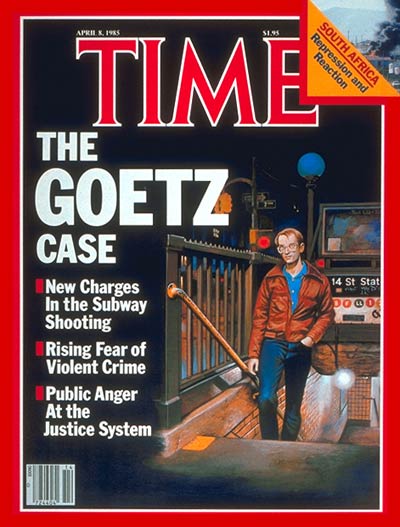
Art Imitates Life: Bernard Goetz

It is amazing how inspiration can come about. I was watching the second episode of Season One of the original Law and Order (Originally broadcast back in 1990) and I notice that the episode is strangely reminiscent of a heated case in New York City during 1984. The episode shows an incident on the New York City Subway where a young white woman pulls a gun out of a crowded Subway train and shoots a number of young black men. Now, sitting there I’m thinking that Law and Order made a few noticeable changes to the Bernard Goetz incident of December 22, 1984. Before I go into what happened on that day almost 27 years ago, allow me to describe to you how the New York City Subway system looked during those days from a person who lived it.

I was in my early teens during that time and the trains and the city were nothing compared to what they are today. The trains were dirty, full of graffiti, lacking air conditioning, stations in disrepair and crime in the city uncontrolled. By the end of 1984 the murder count for the entire city sat at 1,786 with a peak of 2,605 murders in 1990. Consider that in 1995 murders stood at 1,550, 2000 at 952 persons killed and 781 in 2009. People today have it good compared to the early 1980’s, but I digress. That is the world that Bernard Goetz lived in. As per Biography.com’s entry on Bernard Goetz here is how the incident went down:

On December 22, 1984, Goetz entered an empty Manhattan train, carrying an unlicensed .38 caliber revolver. Also on the car were four teenagers: Troy Canty, Barry Allen, Darrell Cabey, and James Ramseur. As witness testimony later stated, Goetz had barely taken his seat when the young men approached Goetz for $5. When Goetz refused, Canty responded, "Give me your money." Suspecting he was being set up for another mugging, Goetz stood up and said, "You all can have it." Goetz started firing his revolver, wounding all four teens. When the train came to a stop, a startled Goetz ran out of the car and eventually fled the city, making his way to Concord, New Hampshire. Eight days after the shooting, Goetz finally turned himself into police.

Where the Mayor of New York City Edward I. Koch stated that “We will not permit people to take the law into their own hands,” the normal folks celebrated the shooter. People saw this incident as a way for the people to take the streets back from the criminal and the thugs who were terrorizing them. On the flip side, race relations in the city, which were already strained, worsened after the Goetz incident. Things came to a head with the two trials against Bernard Goetz.

In the June 1987 trial, Goetz was acquitted of charges of attempted murder and assault at his trial and was sentenced to five years' probation and ordered to undergo psychiatric counseling. The second trial was set for October 1987 for the unlicensed gun charges. The jury found Goetz guilty and sentenced to six months in jail and five years' probation. Goetz’s actions on that subway car in 1984 led to the paralyzing of Darrell Cabey which in turn led to a lawsuit being filed by Cabey in which a judgment against Goetz was $43-million in damages.

Goetz would live a life of brief celebrity after his prison term and has faded into obscurity becoming a footnote for the “good-old days” of the New York City of the 1980’s.

FH

For Further Reading:
- Click Here to access the opinion of the Court of Appeals for the case The People of the State of New York, Appellant, v Bernhard Goetz, Respondent., 68 NY2d 96
- Click Here to access the article WHEN BERNIE GOETZ WAS NEW YORK CITY from the New York Daily News website dated December 19, 2004
- Click Here to access the New York Crime Rates 1960 - 2010 from the Disastercenter.com
- Click Here to access the article Goetz Given 6-Month Term on Gun Charge from the New York Times website dated October 20, 1987
- Click Here to access the article The Goetz Verdict from the New York Times website dated April 24, 1996

Sunday, February 27, 2011

Edward Donald "The Duke" Snider 1926-2011

During the summer of 2007, I visited the exhibit The Glory Days: New York Baseball 1947-1957 located at the Museum of the City of New York. In it I saw first hand the effect that players such as Mickey Mantle, Willie Mays and Duke Snider had on their fans and the city of New York. Listening the song Talkin' Baseball by Terry Cashman also brings back memories of a baseball past that I can only see through newspaper articles and news footage. So when I heard that one of the famed trio of the Golden Age of New York City centerfielders and member of the famed Boys of Summer, Duke Snider passed away at the age of 84, well I felt that had to write something.

Duke Snider was born Edwin Donald Snider September 19, 1926 in the city of Los Angeles California, growing up in the South Central area of the city. Snider was signed by the Brooklyn Dodgers straight out of Compton High School, where Snider was an athletic standout in the sports of baseball, basketball and football. After serving a tour of duty in the Navy from 1944-1946, Snider began his major league career.

Snider debuted with the Dodgers on April 17, 1947 joining a talented team made up with such outstanding players like Jackie Robinson, Pee Wee Reese, Gil Hodges and Carl Furillo. This era is considered to be the Golden Age of New York Baseball. The page for the Museum of the City of New York's exhibit The Glory Days: New York Baseball 1947-1957 describes it as so:

The decade between 1947 and 1957 was the golden age of baseball in New York City. With three major league teams—the Yankees, the Brooklyn Dodgers, and the New York Giants—at least one of whom played in the World Series every year except 1948; two National League teams in an intense rivalry each season; and seven landmark subway series, New York was the undisputed baseball capital of the nation.

From 1947, until they left Brooklyn in 1957, the Dodgers won six National League pennants (1947, 1949, 1952, 1953, 1955, 1956) and winning their only World Series in Brooklyn in 1955. The man known as the "Duke of Flatbush" was a main component of these teams. Snider was a seven time All Star and finished in the top ten of MVP voting six times. Snider continued playing with the Dodgers as they moved to his home town in 1958. He has the distinction of being the last player to get a base-hit at Ebbets Field and the first player to get a hit at Dodger Stadium.

Snider helped the Dodgers win their second World Series in 1959 against the Chicago White Sox. Snider's contract was sold to the New York Mets in 1963 and after a brief return to New York City, Snider's contract was sold to the San Francisco Giants in 1964. Snider would retire in the same year after the Giants released him. Snider would be elected into the Baseball Hall of Fame in Cooperstown in 1980, joining fellow New York Centerfield Greats Willie Mays (1979) and Mickey Mantle (1974).

Former Los Angeles Times staff writer Mike Kupper describes Snider's career as so:

Snider hit 40 or more homers in five consecutive seasons and during the 1950s led all major leaguers in home runs, 326; runs batted in, 1,031; runs scored, 970; and slugging percentage, .569. He finished his career with a lifetime batting average of .295 and 407 home runs, 389 of them as a Dodger, still the team record. He is the only player to have twice hit four homers in the World Series, matching his 1952 feat in '55, the year the Dodgers won the Series and he was named major league player of the year by Sporting News.

Snider remained in baseball as a broadcaster for the San Diego Padres (1969-1971), Montreal Expos (1971, 1973-1986) and the Los Angeles Dodgers (1991), as well as, being a hitting coach for the Montreal Expos (1973-1974).

Having been child in New York City during the 1970's, I would hear the stories about New York's Golden Era of Baseball on baseball telecasts and be envious that I was born too early to have experienced it. Going to the areas of Flatbush and Harlem where the former Ebbets Field and Polo Grounds existed I find it hard to believe that there were major league stadiums erected there once upon a time ago. Another component of the magical era has gone to rest. The Duke has gone to the big ballpark in the sky, joining the Mick in a fabled homerun contest. May the Duke of Flatbush rest in peace.

FH.

For Further Reading:
- Click Here for the Duke Snider obituary written by Mike Kupper from the Los Angeles Times website dated February 27, 2011
- Click Here for the Duke Snider obituary written by Richard Goldstein from the New York Times dated February 27, 2011
- Click Here to access the Duke Snider page from the Baseball Hall of Fame at Cooperstown's webpage
- Click Here to access the transcript of Duke Snider's induction speech given at the Baseball Hall of Fame at Cooperstown on August 3, 1980
- Click Here to access the virtual exhibit of The Glory Days: New York Baseball 1947-1957 provided by the Museum of the City of New York

Monday, January 24, 2011

James Rivington British Publisher! American Spy?

Ever wonder who certain streets are named after? Take my post of December 25, 2007 named Houston Street? Who is it really named after!! as an example. Here I highlight and clarify who Houston Street is named after and no it is not named after Texas hero Sam Houston, read it to see who it is named after. This time around I wanted to highlight who Rivington Street is named after.

Rivington Street is named after James Rivington who some say led a double life while living in New York City during the Revoutionary Era. Rivington was born in London England in 1724 to a family of successful publishers. After his bookstore failed causing him to lose his fortune, Rivington dedcided to start anew in the colonies and in 1760 arrived in Philadelphia. A year later, Rivington would open a new bookstore in New York City where he would be forever be linked to. (PHOTO CREDIT: THE NEW YORK HISTORICAL SOCIETY)

Rivington was a staunch supporter of the British crown and did so in his newspaper which was known as Rivington's Gazetter. At first the newspaper was balanced in its reporting of the news but as events in the colonies took a more rebellious nature the paper took a tone similar to its printer. King's Handbook of New York City 1892 describes one instance where Rivington took the rebellious colonists to task with the revolts following the passage of the Stamp Act of 1765:

In the year 1765 the Stamp Act was passed, and the disruption of America and England began. The New-Yorkers forgot their old-time local controversies, and took sides in the new contest. Rivington's Gazetteer stigmatized the patriots as rebels, traitors, banditti, fermenters of sedition, sons of licentiousness and the like

As you can imagine, press of this kind towards those colonists who were growing more and more anti-British did not go over very well. The rebellious colonists were led by a group known as the Sons of Liberty who grew to become a thorn in the side of the Lieutenant-Governor Cadawallader Colden. Many of their actions took the form of protests, public speeches, erection of liberty poles and to the extreme skirmishes with local redcoats, taking of supply depots and cannons. The Sons of Liberty turned their attention to James Rivington and his Tory newspaper.

As Kara Pierce describes in here scholarly paper A Revolutionary Masquerade: The Chronicles of James Rivington, Rivington's anti-colonist writings caused "satires, effigies and mockeries of Rivington began to appear in writings from popular poets to addresses to the Continental Congress". Rivington seemed to brush off the attacks, often printing them in his paper. Pierce also shows that a war of words had been brewing between Rivington and Captain Isaac Sears, who was considered to be one of New York's leading patriots. Often Rivington printed the letters received by him from Sears and his retort in his paper. These actions infuriated Sears to the point to physical retaliation.

In May of 1775, a group of colonists mobbed the Rivington home and press causing Rivington to flee with fellow Tory Myles Cooper to the British man-of-war Kingfisher. The attacks would come to a head on November 23, 1775 when a group of men on horseback led by Captain Sears attacked on Rivington's printing press. In doing so, the rebels destroyed the press and taking its parts to make bullets. Rivington and his family left New York City for London a disillusioned man only to return to when New York City was under British occupation.

History shows that Rivington continued to print his newspaper through 1783 and after he shut down his operation, Rivington lived with his son something of a poor existence until his death in 1802. Or so we thought. History has a way of making things interesting.

Recent scholarship has brought to light a different angle to James Rivington. It is believed that James Rivington, the staunch Tory publisher was in fact a spy in the employ of the revolutionary spy ring known as the Culper Ring. Based on the research of Robert Townsend's papers by Morton Pennypacker (1872-1956), James Rivington was one of the spies utilized by the Culper Ring and their leader George Washington during the British occupation of New York City. Historian Catherine Snell Crary (1909-1974) published “The Tory and the Spy” in William and Mary Quarterly in 1959 wrote that based on the journals of George Washington's grandson George Washington Parke Custis, James Rivington worked as a spy for the colonies. Historian Philip Ranlet in his book The New York Loyalists states that Rivington worked as a spy for the colonists. As recent as 2006, Kara Pierce has also devoted research to the idea that James Rivington was a spy in the online Journal of History for Binghamton University in the Spring 2006 issue entitled “A Revolutionary Masquerade: The Chronicles of James Rivington”.

Regardless what his reasons for turning against the British, Rivington's actions were essential in the victory of the colonists during the Revolutionary War. Hopefully further scholarship and research can reveal more into the life of James Rivington and maybe he can get some of the credit that he deserves.

FH

For Further Reading:

- Catherine Mary Crary "A Tory and a Spy", William and Mary Quarterly, Third Series, Vol 16 No. 1 (Jan 1959) pp 61-72

- Morton Pennypacker, General Washington's Spies, on Long Island and in New York (New York, Aegean Park Press, 1999)

- Morton Pennypacker, The two spies,: Nathan Hale and Robert Townsend (New York, Houghton Mifflin Co, 1930)

- Kara Pierce “A Revolutionary Masquerade: The Chronicles of James Rivington”, Binghamton University Journal of History Spring 2006

- Philip Ranlet, The New York Loyalists, 2nd Edition (Lanham, University Press of America, 2002)

- New York's Tory Printer New York Times March 1, 1896

Wednesday, December 22, 2010

Brooklyn Navy Yard Fire December 20, 1960

December 17, 2010 marked the 50th anniversary of the mid-air collision of two planes over the skies of New York City. One of the planes landed on Miller Field in Staten Island, the second plane landed on the streets of Park Slope Brooklyn. In total 134 people died. Surprisingly, this wasn’t the only tragedy to affect New York City that holiday season. Situated roughly two miles from the crash site on 7th Avenue and 32nd Street there was a massive fire at the Brooklyn Navy Yard on the future aircraft carrier the USS Constitution. In that accident, 50 workers were killed and 330 were injured. If it wasn’t for Clyde Haberman’s article Recalling a Brooklyn Disaster Otherwise Forgotten from December 21, 2010, I’d have never have known it. Before I go into my views on why this disaster seems to be a footnote in New York City history, let me shed some light on the incident.

According to Charles Grutzner of the New York Times on December 20, 1960 the fire started when a lift truck damaged a 500-gallon fuel tank. The fuel made contact with a welder’s torch causing the temporary wooden scaffold and the other flammable materials used on the construction of the ship to feed the blaze. Within minutes a fire was raging out of control that it took over 12-hours to put it out. Many of the firefighters that were on the scene at the plane crash were also on the scene of the aircraft carrier fire. Watch the following video which chronicles both the Park Slope plane crash and the Brooklyn Navy Yard fire from local news footage of the day for images and more information on both accidents.


In the following days, hearings into trying to resolve the cause of the fire led to accusations by the New York City Deputy Fire Commissioner Albert S. Pacetta that the United States Navy of trying to discredit the Fire Department and their efforts during the fire. Regardless of who was to blame for the accident, the fact remains that 50 civilian dockworkers were killed and 330 were injured without so much as a peep in terms of a public acknowledgement aside from an article in the New York Times.

I made a mention of how certain incidents fall from the mind of people over time in my post on the General Slocum. With that incident, it seems that the lives lost on the fire of the paddleboat are forgotten in comparison to those lives lost on the steamship Titanic a few months later. Why is it that those lives that were lost in the plane crash are honored with a memorial in Greenwood Cemetery and those lost at the Brooklyn Navy Yards are not? Is it possible that we can empathize with people who lose their lives in a plane crash since air travel is something common to every one of us? I really don’t have a concise answer to those two questions. All I’m trying to do is shed a little light on a piece of New York City History that seems to be lost to time.

FH

Wednesday, September 22, 2010

Wall Street Bombing September 16, 1920

Imagine this scene: You are standing on the Northeast corner of Broadway and Wall Street looking eastward. The date is September 16, 1920 and the day is cool and comfortable. You note that the street is bustling with activity in the minutes before noon chime goes off in the above looming Trinity Church. Men and women walk along taking care of their daily business. Street vendors sell their wares to the passing public. It seems like a scene out of the Wall Street from the year 2010, well aside from the armed Federal guards and the street barriers.

You walk down Wall Street towards the corner of Wall and Broad Streets and come face to face with three future landmarks of New York City’s financial district. To your left is Federal Hall, made famous by George Washington and his inauguration as this nation’s first President. Behind you to your right are the columns of the New York Stock Exchange building. In front of you on your right is the JP Morgan building at 23 Wall Street (The view in the above picture is from Federal Hall with the 23 Wall Street in the front and the New York Stock Exchange on the right). You look down at your watch and notice that that the minute hand has joined the hour hand on the number 12. That innocent looking horse drawn wagon that sat across from the Morgan building goes from being innocent to lethal leading to the deaths of 38 people and injuring hundreds more. This is Wall Street, September 16, 1920. (PHOTO CREDIT Mark Lennihan/Associated Press).

What exactly happened on that fateful day? To best describe the event I quote author Kevin Baker in his New York Times review of Beverly Gage’s book The Day Wall Street Exploded: A Story of America in its First Age of Terror:

The bomb was an immeasurably cruel device, most likely dynamite tied to iron sash weights that acted as shrapnel. It blew people apart where they walked out on a cool, late-summer day, tore arms and legs, hands and feet and scalps off living human beings. Others were beheaded or eviscerated, or found themselves suddenly engulfed in flames. Still more injuries were caused by a cascade of broken glass and the terrified stampede that followed.

Given the political climate at the time, it was believed that that those responsible for the attack were radical Anarchists. Later it was believed to have been planned by agents of Soviet ruler Vladimir Lenin. After exhausting investigations by the New York Police Department and the Bureau of Investigations (predecessor to the Federal Bureau of Investigations) of witness statements and numerous arrests with no convictions the case remains officially unsolved.

According to scholars, it is believed that attack was perpetuated by a known radical by the name of Mario Buda (1884–1963) aka Mike Boda. Paul Avrich in his book Sacco and Vanzetti: The Anarchist Background claims that the reason for Buda's attack was in protest of the arrests of his friends Nicola Sacco and Bartolomeo Vanzetti. Sacco and Vanzetti were arrested, tried and executed for their believed roles in the South Braintree (Massachusetts) holdup that led to the killing of a paymaster and a guard on April 15, 1920.

Mike Davis, author of Buda's Wagon: A Brief History of the Car Bomb, states that Buda was a supporter of Luigi Galleani (1861-1931). Galleani was an anarchist theorist and editor of the Cronaca Sovversiva an Italian anarchist periodical. The Galleanist

Why Buda picked Wall Street as a location for his message is unknown. It is also not known whether he acted alone or with other anarchists. What is known is that a message was left in a mailbox on the corner of Cedar Street and Broadway. The message in red letters read as so:

Remember
We Will Not Tolerate
Any Longer
Free The Political Prisoners
Or It Will Be
Sure Death For All of You
American Anarchist Fighters


Why wasn't Buda ever arrested? After the bombing, Buda made his way back to Providence, Rhode Island where after getting a passport from the Italian Vice-Consul, Buda boarded a ship heading to Italy where he remained until his death in 1963.

The Wall Street Bombing of 1920 was the largest terrorist act on American soil until the attack on the Alfred P. Murrah Federal Building in downtown Oklahoma City on April 19, 1995. The attack was the largest terrorist act in New York City history until it was eclipsed by the attacks on the World Trade Center on September 11, 2001.

FH

For Further Reading:
Paul Avrich, Sacco and Vanzetti: The Anarchist Background (Princeton, Princeton University Press, 1991)

Mike Davis, Buda's Wagon: A Brief History of the Car Bomb (London, Verso Press, 2007)

Beverly Gage The Day Wall Street Exploded: A Story of America In Its First Age of Terror (Oxford, Oxford University Press, 2009)

- Click Here for the Trial of Sacco and Vanzetti 1921 page with maps, images and excerpt of the trial

- Click Here for the Palmer Raids post on the FBI Wall of Shame blogpage for some background on the Galleanists and other anarchist groups.