Friday, February 26, 2010

Valentine's Day and the Home Grown Gangster

Now that the corporate "holiday" known as Valentine's Day has come and
gone, I wanted to put a spotlight on someone whose name will forever be linked to the day. Now I'm not sure if this gentleman was a regular Rudolph Valentino in his day but it wasn't his sexual prowess that is linked to the date February 14. It was his aggression, not love, towards his fellow gangster Bugs Moran and his gang, The North Side Gang that is famous, or rather infamous. On the morning of the 14th of February of 1929, seven men were gunned down in cold blood in a warehouse on North Clark Street in Chicago, Illinois. Now you may ask why am I talking about a gangland hit that occured in The Windy City on a New York City history blog site. Well folks, the believed architect of the whole shebang and who would end up being known as Public Enemy Number One was born, raised and learned his craft here on the streets of good old NYC. That man was Al Capone, otherwise known as Scarface.

Alphonsus "Al" Capone was born on January 17, 1899 in what is now the Red Hook section of Brooklyn to Gabriele Capone and Teresina Raiola who hailed from Naples, Italy. His family would eventually settle down in the Park Slope area of Brooklyn on the edge of Park Slope. Though Capone was a bright child, the lure of the street proved to be too hard to resist. It was on these rough and tumble streets that Capone started his hands on education in the life of crime. Capone would leave school while in the sixth grade at the age of 14, never to attend school again. Capone had joined a number of kid gangs such as the Brooklyn Rippers and the Junior Forty Thieves. These gangs proved to be a minor league of sorts for the major league of New York City gangs: The Five Points Gang (along with fellow gangster Charles
"Lucky" Luciano). The leader of the gang was none other than Johnny Torrio. It was while associated with Johnny Torrio that Capone's path would be set in stone.

Johnny Torrio took Capone under his wing while with the Five Pointers and in 1917 got him a job at Frankie Yale's Harvard Inn. The club was located in Coney Island Brooklyn and would be famous for the place where Capone would earn his nom-de-guerre. After making some inappropriate comments to a female patron, Lena Gallucio. Her brother, Frank Gallucio, would later return to the club looking for and confronted Capone. After all was said and done, Capone's face had been slashed leaving a nasty scar on the left side of his face earning him the nickname of Scarface. In a later twist concerning Capone and Yale, it is believed that Capone ordered the hit that would lead to Frankie Yale's assassination July 1, 1928. The suspected hit came about due to a disagreement about the protection of Capone's bootlegging merchandise. It is believed that a number of the hitmen that executed the hit on Yale also participated the St. Valentine's Day Massacre of 1929.

It was around this same time that Capone met a young lady named Mary "Mae" Couglin. They would end up having a son together whom they named Albert Francis "Sonny" Capone on December 4, 1918. They would be wed on December 30th of the same year at the St. Mary Star of the Sea Church which is located in Carroll Gardens, Brooklyn.

Capone's criminal activities would eventually catch up to him in the form of a prison term at Sing Sing Prison, located in Ossining New York in 1919. Once released from prison in 1920, Capone was asked to join Torrio who was in Chicago working gangster James "Big Jim" Colissimo. Capone worked in various bars and clubs owned and operated by Torrio until the day that Torrio took over Colissimo's empire after his assassination. With Torrio as the boss, Capone would become his right hand man, eventually becoming the boss in 1925. The rest as we know it is history.

For further reading check out these websites:
The Gridskipper has an amazing page on Al Capone's Brooklyn with pictures. Click Here.
The Federal Bureau of Investigation's Webpage on Al Capone. Click Here.
A Webpage called Blood, Roses and Valentines about the St. Valentine's Day Massacre. Click Here.
The Chicago Historical Society page on Al Capone. Click Here.

Sunday, February 7, 2010

Why is there a Castle Hill in the Bronx if there is no Castle or Hill

So, for years now my wife and I have been joking about why is the Castle Hill area named as such since there are no castles or hills in the area. So as I've been known to do, I searched around and found out. Here goes folks.

While Adriaen Block of Dutch New York fame (I'll get back to him in a later post) and his crew sailed from New Amsterdam to Holland on the newly built Onrust (Restless) loaded with furs and goods, the ship sailed along what is now known as The East River (To see a replica of the ship that was constructed by the Onrust foundation for the NY400 celebration click here). While following the shoreline of what is now The Bronx, the crew noticed what to them looked like a large castle on a hill. As they grew closer, they saw that it was large fortification of logs which rested on a sixty foot promontory. The fort was given the name Kasteel (Which is Dutch for Castle) by Adriaen Block and since it rested on a hill the name for the area
became "Castle Hill"

Who did the Kasteel belong to?
The fort belonged to The Siwanoy tribe. They were a branch of the Mohegans which in turn were a sub-tribe of The Algonquins. The Siwanoy inhabited the land along the coastlines of the Long Island Sound, Eastchester Bay, and Pelham Bay, between Connecticut and the southern Bronx. As was documented in Russell Shorto's The Island at the Center of the World, The Siwanoy was famous for their massacre of members of the Split Rock settlement (including Anne Hutchinson among others) located within current day Pelham Manor. This attack came in retaliation of New Netherland governor Willem Kieft's February massacres of Wappinger refugees from Wecquaesgeek at Corlaer's Hook and Pavonia across the Hudson River in New Jersey.

So there it is.

For additional reading:
For more information on Split Rock and how to get there, click here
For more information on the Siwanoy, click here.
New York City Parks Department page on the Siwanoy Trail, click here
The Onrust Project 2006-2009, click here

Monday, January 18, 2010

BoCoCa??? Really???

I'm taking a bit of a different tact with this post. To be perfectly honest, this post should go on my other blog page: The Observations and Rants of a Native New Yorker (I know, I should be ashamed by the cheap mention of my other blog on this one but I'll take what I can get). Since there is a bit of a historical New York City slant to this one, I decided on it being here. So let's ride with it.

Alright, this whole naming of neighborhoods with an acronym is going too far. I'll admit, TriBeCa (Triangle Below Canal Street) has a certain caché to it but isn't bad enough that Brooklyn has a neighborhood named after a big-eared elephant (Actually DUMBO an acronym for the Down Under the Manhattan Bridge Overpass not the Disney character). Now there's a new one called BoCoCa, which is an amalgam of the neighborhoods of Boerum Hill, Cobble Hill and Carroll Gardens. Umm, excuse me, but what was wrong with Boreum Hill, Cobble Hill and Carroll Gardens. Not only is gentrification stripping classical New York City neighborhoods of their look and character, now names are being wiped away into the annals of history. Similar to the movement of renaming Hell's Kitchen to Clinton, the same is happenening to the good old "Brook-a-line". Let me clue you good folks in on where the names of Boerum Hill, Cobble Hill and Carroll Gardens comes from.

Boerum Hill derives its name from the Dutch colonial landowners of the area: The Boreum family. The patriarch of the family Willem Jacobse Van Boerum immigrated to New Amsterdam in 1649. His great grandson Simon Boerum was a landowner of the area that is named after his family.

The Boerum Hill Neighborhood Assocation
An excellent page on things that have faded into NYC History

The exact history behind the name Cobble Hill is somewhat of a mystery to me. What I have read is that the original name of the area was "Cobleshill". On the hill, a fort was built by General Nathanial Greene for the defense of Long Island (Brooklyn) during the Revolutionary War. The neighborhood was designated an Historic District on December 30, 1969.

City of New York Community Board Six webpage
A New York Times article on Cobble Hill from 2001
The Gowanus Lounge on Blogspot

Carroll Gardens is named after Charles Carroll of Maryland. Carroll was a Revolutionary War veteran and the only Roman Catholic to sign the Declaration of Independence The neighborhood was designated an Historic District on September 25, 1973.

The City of New York Community Board Six Webpage
The Brooklyn Public Library's page on Carroll Gardens
The Carroll Gardens Neighborhood Association Webpage

Sure, some of you will read the information on the links that I posted and you'll see that the names of these neighborhoods were changed from the generic South Brooklyn because of the need by some of its residents to shed the negative stigma of the past and to pave the way for gentrification. Which is what I am describing with the umbrella term of BoCoCa. At least the names of Boerum Hill, Cobble Hill and Carroll Gardens have their roots in New York and American Histories. To me, BoCoCa sounds way too fake and so "Un" New York. So come on, let's leave the names on these neighborhoods alone. Call them as they should be called.

BUT, if you insist on changing the way these neighborhoods are referred to, check out these sites:

The Gothamist: BoCoCa: Not a New Cocoa
A PDF file from Bigapplegreeter.org on BoCoCa

So let me know what you think. Change them or not.

Thursday, January 14, 2010

Who Was Asser Levy

I remember, as a child,driving around with my dad throughout New York City. To be honest, I really can't remember what we were doing or where we were coming from. But I do specifically remember a certain route he always took to get to the FDR Drive. My dad would drive east along 23rd Street then take a left on to the FDR Drive service road which he would take to the highway. There was always a street along the way that always caught my eye. The name of that street was Asser Levy Place. I always wondered who Asser Levy was. Well, here he is.

Asser Levy's fate was intertwined with that of the Quakers who I had mentioned in a previous post on the Flushing Remonstrance of 12/27/1657. How are they related you may ask. Well, in the same way that the Dutch Director-General of New Amsterdam Peter Stuyvesant opposed the Quakers in the New Amsterdam colony, Stuyvesant opposed the Jews. But before I get to the religious conflict in New Amsterdam, allow me to shed some light on another conflict concerning another Dutch colony: Nieuw Holland (Dutch Brazil).

The colony of Nieuw Holland was located along parts of Northeastern and East of current day Brazil. Settled by the Dutch West India Company the colony was one that promoted religious tolerance since the aim of the colony (as those of the other Dutch West India Colonies) was to make money. This religious tolerance attracted a large number of Jews, especially Sephardic Jews (those from Spain) to the area. To highlight how the Jewish population settled in the area, it is believed that The Kahal Zur Israel Synagogue is the oldest Synagogue in the of the Americas, located in the town of Recife. This Reuters article from Haaretz.com offers more information on the Kahal Zur Israel Synagogue. Click here.

Relative peace lasted in the area until it was taken over by the Portuguese in January of 1654. A final treaty was signed on August 6, 1661 giving Portugal total control of the former Dutch colonies in Brazil. Click here for more information on the Treaty of the Hague 1661. The thought of the Catholic Portuguese taking over brought back images of religious persecution and violence against the Jews. This caused a small number of Jewish citizens to flee from Nieuw Holland. The Jews boarded a ship called the Sainte Catherine which was headed to the Dutch colony of Nieuw Amsterdam.

You would think that going from one Dutch colony to another would be an easy transition. Unfortunately for the Jewish refugees, the colony that they would arrive to on September 1654 was controlled by Peter Stuyvesant, a fiercely religious member of the Dutch Reformed Church. A group of the size that made up the Jewish refugees (23 in total) needed permission from the local authorities to take up residence. Stuyvesant refused, echoing many of the Anti-Semitic rhetoric that would be heard centuries later to describe the Jews: Usury, Deceitful, Infectious, Blasphemers of the name of Christ to name a few. Since Stuyvesant needed approval from his superiors in Amsterdam, he sent his objections to the Jewish refugees in writing. Not willing to remain passive, the Jews also sent their own letter to Amsterdam. They directed their request to remain in Nieuw Amsterdam to the Jewish community of Amsterdam.

The Jewish community enjoyed religious and economic freedom in Amsterdam and used their influence in Amsterdam to file a petition to the Dutch West India Company. It should be noted, that many a shareholder in the Dutch West India Company was Jewish who made his or her profits engaging in trade under the Dutch banner throughout the world.

As how it would be repeated with the Quakers, the Dutch West India Company went against its Director-General Stuyvesant and decreed that the Jewish refugees could travel in and out of Nieuw Amsterdam, engage in trade and live in the colony. These rights came with restrictions:

- The Jews could not train with the guard or militia. A special tax would replace military service by the Jews
- Barred from trading outside the colony
- Barred from building permanent houses and symbols of their faith
- The Jews must care for their own poor. The poor Jews would not be wards of the colony


Stuyvesant used all the force at his disposal to enforce the rules the company placed on the Jewish refugees. So, how does Asser Levy fit into this whole scenario.

By 1655, Levy became the most prominent member of the Jewish refugees in Nieuw Amsterdam and continued the fight for freedom in the colony. Through his efforts, the restrictions placed against the refugees by the Dutch West India Company were lifted:

- The Jews could now join the militia and not have to pay the special tax
- They were allowed to trade within the Hudson and Delaware Valleys
- They were allowed to build houses and places of worship, which they did so along Whitehall Street


Asser Levy's efforts earned the Jews the right to citizenship in 1657 allowing them full rights as burghers within the colony. These 23 Jewish refugees from Nieuw Holland would become the first permanent Jewish settlement in North America. As for Asser Levy he would go on to become New York's first kosher butcher ands a founding member of Shearith Israel, the country’s first Jewish congregation. The street to the west of the recreation center bearing his name was named after Levy by local law in 1954. What's ironic is that the playground and recreation center which bears Asser Levy's name is only a short block from the housing complex that bears the name of Peter Stuyvesant (Stuyvesant town). To see the area on Google Maps, Click Here. Even along the city streets of modern day New York, they are not that far from each other.

For Further Reading:

Hasia R. Diner The Jews of the United States, 1654-2000 (Berkeley, University of California Press, 2004);

Russell R. Shorto The Island at the Center of the World (New York, Vintage Books, 2005)

Wednesday, April 15, 2009

Jackie Robinson Day April 15

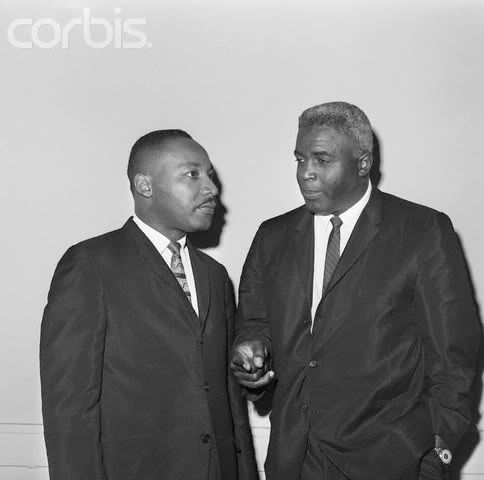
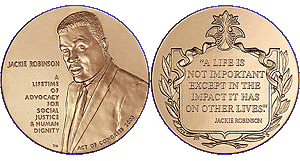
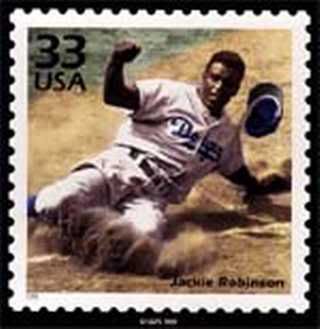
April 15 is known to many people as the day that the TaxMan gets his due. But for baseball people, April 15th has a different significance. On April 15th, 1947, a young 28-year-old man took the field at Ebbets Field for the Brooklyn Dodgers in a game against the Boston Braves. While playing first base, he had no hits in three at bats. Though this description is somewhat ordinary, the player was anything but. For the first time since the late 1800’s, a black man was allowed to play professional baseball within the ranks of Major League Baseball. That man was Jack Roosevelt "Jackie" Robinson (January 13, 1919-October 24, 1972).

"It kills me to lose. If I'm a troublemaker, and I don't think that my temper makes me one, then it's because I can't stand losing. That's the way I am about winning, all I ever wanted to do was finish first." Jackie Robinson

Robinson brought an energy and excitement to both the field of play that was only seen on the fields that the Negro Leagues baseball was played on. His determination on the field translated to a form of baseball that emphasized speed and aggressive baserunning that many of the fans of Major League baseball had not seen. Where Robinson was aggreesive on the field he was patient with the abuse that was hurled towards him from not only fans but from fellow players who often insulted him and threatened to not take the field if Robinson played in the game.

"A life is not important except in the impact it has on other lives."Jackie Robinson


The significance of Robinson’s playing for the Dodgers was not only felt within the baseball ranks. In terms of society, Robinson would become one of the icons of the growing civil rights movement. As Buck O'Neill says in the documentary Pride and Preserverance: The Story of the Negro Leagues:

"Jackie Robinson, that was the beginning of the civil rights movement. That was before Brown vs. The Board of Education. That was before Sister Rosa Parks said 'I'm not going to move to the back of the bus today'. Martin Luther King was a sophomore at Spellman at the time. That's what got the ball moving."

Robinson’s playing of professional baseball, gave many young black men and women a positive role model. If Jackie could do it, why couldn’t they do it.

"The right of every American to first-class citizenship is the most important issue of our time." Jackie Robinson

His later life was devoted to the enhancement and advancement of the civil rights movement not only for African American but for all Americans.


"With all major league players, coaches and umpires wearing Jackie's No. 42, we hope to demonstrate the magnitude of his impact on the game of baseball, Major League Baseball will never forget the contributions that Jackie made both on and off the field" Commissioner of Major League Baseball Allen H. “Bud” Selig

"The way I figured it, I was even with baseball and baseball with me. The game had done much for me, and I had done much for it." Jackie Robinson

Today, every Major League player will wear number 42 as their uniform number in honor of the breaking of the color barrier by Robinson 62 years ago.

"When Jack stepped foot on the field on April 15, 1947, and broke the color barrier in baseball, he became a catalyst for social change in America," Rachel Robinson

That he did Mrs. Robinson, and thank you for all that your husband and family have done. The world would not be the same without it.

Here are some links to check out about Jackie Robinson:
- The Official Jackie Robinson Page
- Time Magazine 100 Most Important People of the 20th Century Listing for Jackie Robinson
- U.S. Library of Congress Baseball and Jackie Robinson Page
- Afro-Am Listing for Jackie Robinson
- The National Baseball Hall of Fame and Museum listing for Jackie Robinson
- The Jackie Robinson Foundation